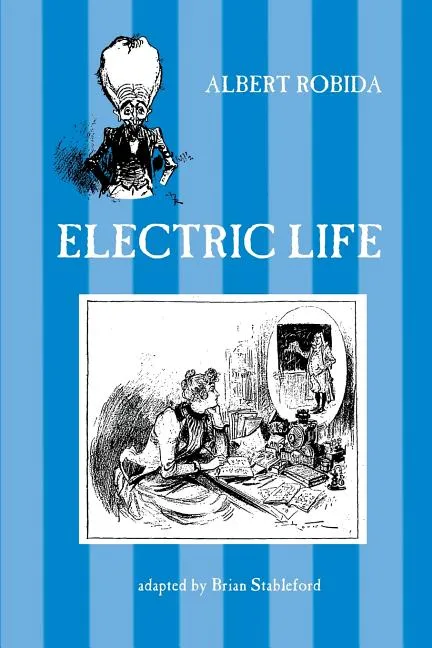
Electric Life
Report an issue
Tell us what's wrong and we'll take a look.
Thanks – we got it. We'll review and follow up if needed.
In Electric Life (1892), Albert Robida imagined the life of the future, imbued with all kinds of fantastic devices meant to simplify the lives of their users. The father of science fiction illustration, and the author of The Clock of the Centuries and The Adventures of Saturnin Farandoul, Robida (1848-1926) was the most significant of all of Jules Verne's successors. The novel follows the adventures of the great inventor Philox Lorris, who wants his son to marry a woman whom he does not love, instead of his sweetheart, whom Philox dislikes. This traditional love triangle allows Robida to unleash his sarcastic predictions, extrapolating them to what he thought were absurd extremes; but which today's readers will think tame in comparison with our modern world. Electric Life no longer qualifies as futuristic fiction, or alternative history, but it does qualify as steampunk fantasy -- perhaps the ultimate steampunk fantasy, given that it possesses an innocence that no modern writer, jaded by an excess of historical knowledge, could ever duplicate. ILLUSTRATED WITH 100 ORIGINAL ILLUSTRATIONS BY ALBERT ROBIDA.
Albert Robida
Albert Robida (14 May 1848 - 11 October 1926) was a French illustrator, caricaturist, novelist and editor whose imagination yoked medieval nostalgia to audacious visions of the machine age-and of mechanised war. A carpenter's son from Compiègne, he exchanged notarial drudgery for the Parisian press, co-founding the weekly La Caricature (1880-92) and ultimately producing some 60,000 drawings and eighty books, inspiring one critic to call him "an inexhaustible dynamo."Robida's renown rests on three graphic novels that mapped the coming century: The Twentieth Century (1883), War in the Twentieth Century (1887) and Electric Life (1890). Delighting readers with air-taxis, videophones and emancipated women, they also forecast the darker face of progress. War in the Twentieth Century depicts fleets of armoured airships bombarding cities, mobile artillery slinging poison shells and wireless "telephotographs" directing fire-devices chillingly close to the zeppelins, gas and aerial reconnaissance of 1914-18. His later serial La Guerre Infernale (1908) pushed the vision further, showing orbiting gun-platforms and continent-spanning alliances that eerily pre-echo the total wars of the twentieth century. Historians now credit Robida-long overshadowed by Jules Verne-as the first illustrator-novelist to give war its modern technological grammar.Yet his futurism was never mere technophilia; it was tempered by gentle satire and a preservationist's love of heritage. He mocked gadget-drunk Parisians even as he designed the hugely popular "Vieux Paris" medieval quarter for the 1900 Exposition Universelle, warning that unfettered progress could hollow out the past. This tension between wonder and caution suffuses his work, where rococo façades cling to flying hotels and Notre-Dame doubles as an aerodrome.Robida's private life was as modest as his art was extravagant. Near-sighted and shy, he sketched from suburban Neuilly while raising seven children, yet delivered illustrations and text with clockwork punctuality. The First World War, which claimed his youngest son and confirmed his most ominous predictions, darkened his outlook. Although his ornate cross-hatching slipped from fashion after 1918, later critics hailed him as "the Jules Verne of illustration," recognising that his fusion of word and image-especially his clairvoyant visions of industrialised conflict-helped ordinary readers imagine, and fear, the twentieth century before it arrived.
More by Albert Robida




Why Readwise Books?
Readwise Books is an ebook & audiobook platform that automatically logs how much you and your friends read, making it fun and easy to read more. Learn more →