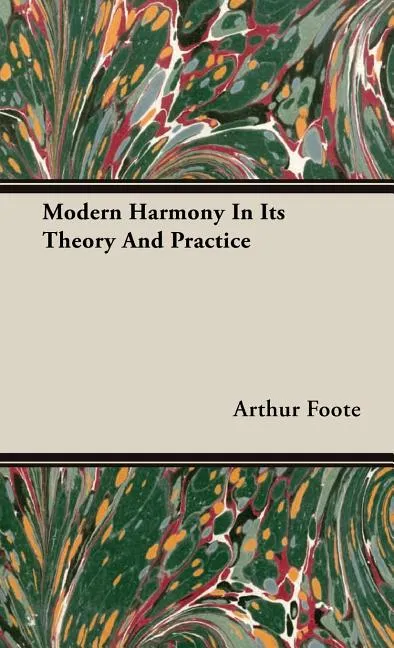
Modern Harmony In Its Theory And Practice
Report an issue
Tell us what's wrong and we'll take a look.
Thanks – we got it. We'll review and follow up if needed.
MODERN HARMONY- IN ITS THEORY AND PRACTICE by ARTHUR FOOTE. Originally published in 1905. PREFACE: THE title of this work indicates the aim of the authors. Not a few statements and rules have been current in text-books that., from the point, of view of composers and of the best teachers to-day, are unnecessary and sometimes even incorrect. When we find a rule constantly broken by one great composer after another, it is probable that the rule ought to be mod ified or given up, and not that the composers are wrong. It is the inten tion that statements and rules in this book shall be expressed with exact truth, and explained when real explanation is possible. It has also been remembered that better work is secured by directions as to what may be done, than by laying too much stress upon what is forbidden. About some matters there is a marked difference of opinion among theorists such things cannot be considered as settled for good and all, and no definite statement should be made excluding other well-grounded points of view, e. g. the chords of the llth and 13th. The chord of the 6th has been treated with more detail than usual, an attempt having been made to analyze and classify the features that make this chord so difficult for the student. While the old strict rules as to secondary 7ths are given fully, the modern theory and use of these chords have received just consideration. The chord of the 9th has been discussed as a largely independent chord it was also obvious that the growing feeling about chords of the llth and 13th ought to be recognized, although the opinion of the authors, as ex plained in the chapter on that subject, is that these latter can seldom be classified as independent chords. It is believed that the treatment of chromatic alterations in chords, and of the augmented 6th, 6-5 and 6-4-3 chords is in accordance with present thought, and that this is also the case as regards suspension. The chapter on the old modes is necessarily brief, but it is hoped that it may lead the student to further investigation of an important and inter esting question. It is often the case that exercises with figured basses are written, correctly, but only mathematically, by simply reckoning each chord as-a kind of puzzle, without reflecting that the whole thing means music after all. The most difficult thing, for one not used to it, is the having a mental conception of the real sounds of the symbols written down in other words, hearing with the eye. Education now is directed to the thing, not to the symbol. As the practical way of working in that direction, in this book from the very beginning the harmonizing of melodies goes step by step with the writing from figured basses. It is hoped that the illustra tions quoted from many composers will be of help by showing what has actually been done with our harmonic material. For matters connected with acoustics 5, 13, the student is referred to Helmholtzs book On the Sensations of Tone, and to the essay on Partial Tones in Groves Dictionary of Music BOSTON, August, 1905. Contents include: I INTERVALS 1 Consonance and dissonance, 7 Inversion, 9. II THE SCALES 11 Circles of 5ths, 13 Relative minor, 15 Chromatic, 16 Tonic, etc., 17. in TRIADS 18 Chord defined, 18 Doubling of intervals, 19 Open and close position, 20 Similar motion, etc., 22 Consecutive 8ves and 5ths, 24 Voice-leading, 27 Leading-tone, 28 Rules for triads, 29. IV EXERCISES WITH TRIADS IN MAJOR KEYS 31 Directions as to figured basses, etc., 31 Exercises, 34. V EXERCISES IN HARMONIZING SOPRANO MELODIES ....... 36 Triad successions in major keys, 36 Exercises, 37. VI TRIADS IN MINOR KEYS 38 Additional rules, 39 Tierce de Picardie, 42 Triad successions in minor keys, 43 Three-voice writing, 43...
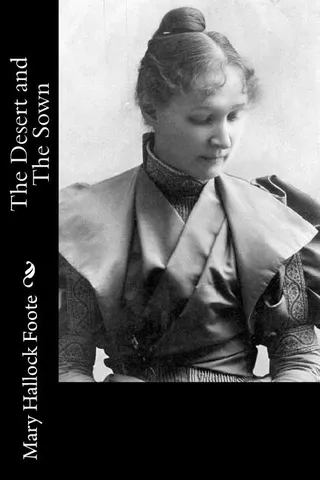
Mary Hallock Foote
Mary Hallock Foote (1847-1938) was an American writer and illustrator born on November 19, 1847, in Milton, New York. She studied painting at the Cooper Institute in New York City, where she was mentored by the renowned artist Winslow Homer. Foote gained recognition for her illustrations, contributing to prominent magazines like Harper's Weekly and Scribner's Monthly. Her artwork often depicted the rugged realities of life on the Western frontier, capturing the struggles and unique ways of life in mining communities. In addition to her illustration career, Foote wrote novels and short stories, many of which were inspired by her travels in the West. Her most famous work, The Led-Horse Claim, draws from her personal experiences living in mining camps. Foote also explored themes of personal and social challenges, particularly the roles of women in frontier life. Although Foote faced financial difficulties later in life, her literary and creative achievements were recognized in the 1930s. Her work offers valuable insight into the American West, documenting the complexities of life in frontier communities while highlighting her distinctive perspective on the era.
More by Mary Hallock Foote


Why Readwise Books?
Readwise Books is an ebook & audiobook platform that automatically logs how much you and your friends read, making it fun and easy to read more. Learn more →