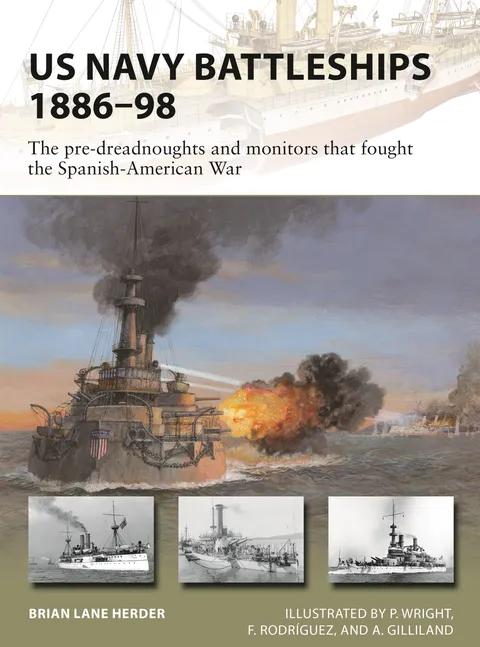
US Navy Battleships 1886–98
The pre-dreadnoughts and monitors that fought the Spanish-American War
Report an issue
Tell us what's wrong and we'll take a look.
Thanks – we got it. We'll review and follow up if needed.
After the American Civil War, the US Navy had been allowed to decay into complete insignificance.
Yet, the commissioning of the modern Brazilian battleship Riachuelo and poor performance against the contemporary Spanish fleet, forced the US out of its isolationist posture towards battleships.
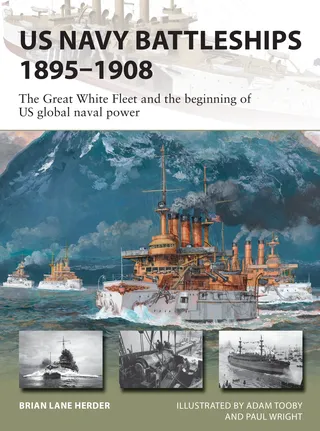
The first true US battleships began with the experimental Maine and Texas, followed by the three-ship Indiana class, and the Iowa class, which incorporated lessons from the previous ships. These initial ships set the enduring US battleship standard of being heavily armed and armoured at the expense of speed.
This fully illustrated study examines these first six US battleships, a story of political compromises, clean sheet designs, operational experience, and experimental improvements. These ships directly inspired the creation of an embryonic American military-industrial complex, enabled a permanent outward-looking shift in American foreign policy and laid the foundations of the modern US Navy.
Brian Lane Herder
Brian Lane Herder graduated with a BA in History from the University of Kansas in 2003, and a Masters of Library Science from Emporia State University in 2009. He is a legislative librarian for the Kansas state government and his historical research interests include the US military, naval warfare, and World War II. He has published various titles with Osprey including NVG 286 US Navy Battleships 1895-1908 and NVG 293 US Navy Gunboats 1885-1945.
More by Brian Lane Herder


Why Readwise Books?
Readwise Books is an ebook & audiobook platform that automatically logs how much you and your friends read, making it fun and easy to read more. Learn more →