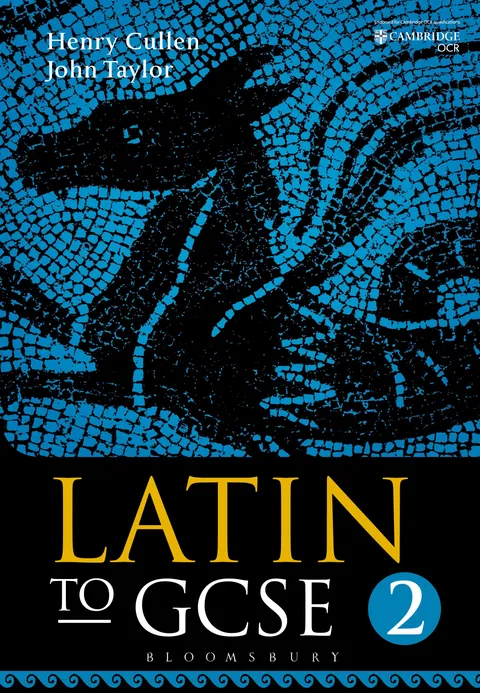
Latin to GCSE Part 2
Report an issue
Tell us what's wrong and we'll take a look.
Thanks – we got it. We'll review and follow up if needed.
A companion to Bloomsbury's popular two-volume Greek to GCSE, this is the first course for Latin students that directly reflects the curriculum in a clear, concise and accessible way. Enhanced by colour artwork and text features, the books support the new OCR specification for Latin (first teaching 2016) as well as meeting the needs of later students, both at university and beyond.
Written by two experienced school teachers, one also an examiner, the course is based on a keen understanding of what pupils find difficult, concentrating on the essentials and on the explanation of principles in both accidence and syntax: minor irregularities are postponed and subordinated so that the need for rote learning is reduced. User-friendly, it also gives pupils a firm foundation for further study.
Part 1 covers the basics, whilst Part 2 introduces a wider range of grammatical forms and constructions, with a vocabulary of 450 words and reading material about the developing Republic, the war with Hannibal, the rise of Julius Caesar, and Augustus and the early emperors. Practice passages and revision sentences for GCSE complete Part 2, which has a reference section covering the whole course.
Henry Cullen
Henry Cullen teaches Classics and is Director of Studies at St Albans High School for Girls, UK, and is co-author with John Taylor of a new two-volume course, Latin to GCSE (Bloomsbury, 2016).
More by Henry Cullen
John Taylor
John Taylor, a journalist for more than two decades, has been a contributing editor at New York magazine and a senior writer for Esquire. He is the author of four books, including The Count and the Confession, a New York Times Notable Book of the Year, and Falling, which Entertainment Weekly ranked as one of the five best nonfiction books of 1999. He lives in East Moriches, New York, with his wife, Jeannette Walls.
More by John Taylor









Why Readwise Books?
Readwise Books is an ebook & audiobook platform that automatically logs how much you and your friends read, making it fun and easy to read more. Learn more →