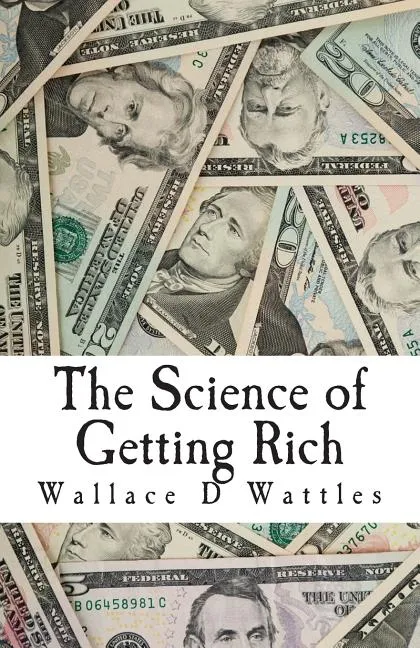
The Science of Getting Rich
Report an issue
Tell us what's wrong and we'll take a look.
Thanks – we got it. We'll review and follow up if needed.
This book - the ideal present for a loved one - is now also available in large print and Extra Large Print.
The Science of Getting Rich is Wallace D. Wattles' masterpiece; more than just another book on making money, it is a book of distilled wisdom that guides the reader towards both acquiring wealth, and living a more fulfilled life.
One of the inspirations behind Rhonda Byrne's The Secret, The Science of Getting Rich employs techniques including the Law of Attraction in a simple and straight forward manner that can be understood by all.
Perhaps this book is best described by Wallace D. Wattle himself: "There is a science of getting rich, and it is an exact science, like algebra or arithmetic. There are certain laws which govern the process of acquiring riches; once these laws are learned and obeyed by any man, he will get rich with mathematical certainty."
Wallace D Wattles
Wallace Delois Wattles was an American who wrote about New Thought. He lived from 1860 to 1911. He isn't very well known as a person, but his writing is still used in the New Thought and self-help groups and is still in print. Wattles's most well-known work is a book he wrote in 1910 called The Science of Getting Rich. In it, he talks about how to get rich. Florence wrote that in the three years before he died, "he made a lot of money and was healthy, except that he was very weak." Wattles died in Ruskin, Tennessee, on February 7, 1911. His body was taken home to be buried in Elwood, Indiana. As a sign of respect, all of the companies in the town closed for two hours in the afternoon of the day of his funeral. His daughter thought it was "untimely" that he died at age 51, because in the year before, he had written two books (The Science of Being Well and The Science of Getting Rich) and ran for public office.
More by Wallace D Wattles



Why Readwise Books?
Readwise Books is an ebook & audiobook platform that automatically logs how much you and your friends read, making it fun and easy to read more. Learn more →