Report an issue
Tell us what's wrong and we'll take a look.
Thanks – we got it. We'll review and follow up if needed.
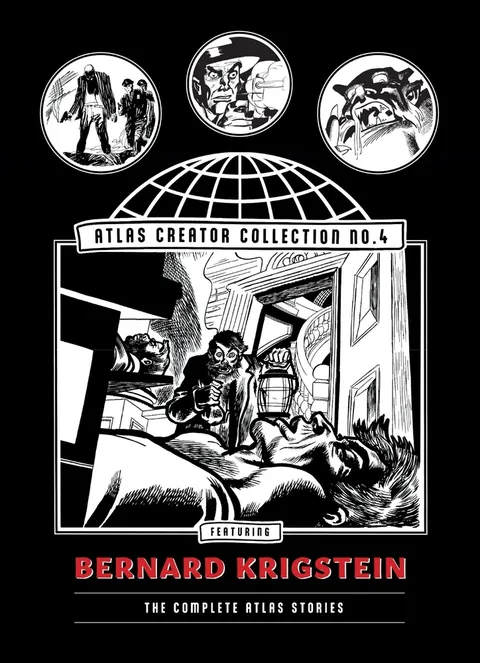
Krigstein was the only Golden Age artist with a Bachelor of Fine Arts degree, and he approached the black-and-white idiom of comics from the perspective of a student dissecting the drawings of the old masters--in this case those old masters included Jack Kirby, Mort Meskin, Alex Raymond, Jerry Robinson, and many others. Already a seasoned comic book veteran when he arrived in mid-1951, Krigstein's two-year tenure at Atlas can be seen as a vital bridge to his artistic maturity. Story by story, page by page, he stretches and refines the Atlas house style expected of its artists to its outer limits, then defies that convention to forge the personal aesthetic he'll continue to refine at EC.
After EC's collapse in 1956, Krigstein returned to Atlas to create his final body of work in comics: 29 short-form experiments demonstrating the infinite possibilities inherent in the art of graphic narrative. "I used them as a medium for dramatizing the breakdown technique, to show the limitless ways that a comic book story could unfold. I wanted to show that the form was fluid and dynamic and should not be considered a static form." Guest editor and Krigstein biographer Greg Sadowski's introductory historical essay traces the arc of Krigstein's development and his efforts to elevate the stature of a medium that was dismissed as disposable juvenile escapism.
Bernard Krigstein
Bernard Krigstein (1919-1990) was trained as a classical painter, but early on he recognized the artistic potential of the comics medium. He worked for major publishers including Harvey, Fawcett, Atlas (Marvel) and National (DC), in 1952 he moved to EC Comics, where his work is widely recognized as among the most innovative in comics history.
More by Bernard Krigstein




Why Readwise Books?
Readwise Books is an ebook & audiobook platform that automatically logs how much you and your friends read, making it fun and easy to read more. Learn more →