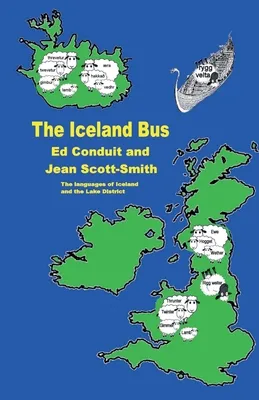
The Iceland Bus
Report an issue
Tell us what's wrong and we'll take a look.
Thanks – we got it. We'll review and follow up if needed.
This book explores the linguistic connections between Cumbria, Iceland and Scandinavia. The English Lake District in 600CE was peopled by Cymbrogi - 'companions' in Welsh and they called it Rheged. Traces of their speech can now include yan-tan-tether counting. Angles with their own Germanic speech from the kingdom of Northumbria expanded westwards and displaced them. The distinctive vowels of old Northumbrian English still dominate Cumbria, the north east, and Scotland. Then some Vikings who had settled to farming around their capital Yorvik moved westwards as far as the Eden valley. Separately, a group of refugees from the Isle of Man found asylum in the central Lakes. The Iceland Bus also took colonists in the other direction, as most of the first women colonists of Iceland came from Britain. A comprehensive glossary of Lakeland vocabulary shows the distinctive sound of West Norse. These colonists spoke a slightly different dialect of the Donsk tunga that still provides hundreds of common nouns and place names in modern Cumbria.
The Authors
Jean Scott-Smith lives in Shap where she was born and has spent all her life, she can trace her father's family in the parish for over 500 years. She married and raised two children then worked in hospitality and catering before moving into administration before retirement, and now holds the position of Parish Clerk. She is a natural speaker of Westmorland Dialect and has been involved as an officer of the Lakeland Dialect Society for over 40 years and holds the position of Secretary. She is Vice Chairman and a founder member of Shap Local History Society.
Edward Conduit lives in the West Midlands but married into Cumbria, as his wife and mother-in-law come from Langdale. He has practised as a clinical psychologist and also taught speech therapists. His interest in language was stirred at this time so he went on to gain a Master's degree in linguistics at Manchester University. His other books include "The Black Country Dialect", "Lakeland Language" and The Body Under Stress". Discover other books by Ed Conduit at Kindle.
Laghamon
Layamon was an English priest and writer active around the year 1200, recognized for composing one of the earliest substantial works in the English language after a long period dominated by French and Latin literature. His most notable contribution reflects a strong dedication to preserving cultural memory through poetic narrative, drawing from earlier traditions while shaping a distinctly English literary voice. Writing in an alliterative style influenced by Anglo Saxon forms, he demonstrated a conscious effort to maintain older linguistic patterns during a time of transition. His work explores themes of history, legend, leadership, and identity, blending mythological elements with reflections on societal structure. Through his storytelling, he helped bridge the gap between Old English traditions and emerging Middle English literature. Although little is known about his personal life, his legacy remains significant for establishing a foundation for future English literary expression and reinforcing the importance of vernacular language in recording history and legend.
More by Laghamon


Why Readwise Books?
Readwise Books is an ebook & audiobook platform that automatically logs how much you and your friends read, making it fun and easy to read more. Learn more →