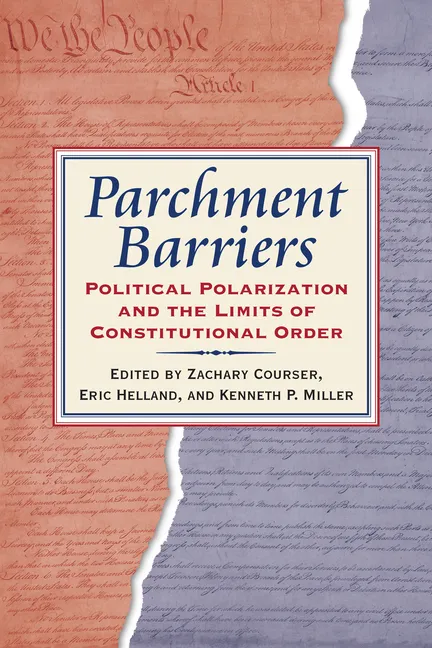
Parchment Barriers
Political Polarization and the Limits of Constitutional Order
Report an issue
Tell us what's wrong and we'll take a look.
Thanks – we got it. We'll review and follow up if needed.
The nation's founders, clearly concerned about political division, designed the Constitution with numerous means for controlling factions, restraining majority rule, and preventing concentrations of power. In chapters that span the major institutions of American government, the authors of Parchment Barriers explore how partisans are pushing the limits of these constitutional restraints to achieve their policy goals and how the forces of majority faction are testing the boundaries the Constitution draws around democratic power. What, for instance, are the dangers of power being concentrated in the executive branch, displaced to the judiciary, or assumed by majority party leaders in Congress? How has partisan polarization affected the nature, size, and power of the administrative state? And why do political parties, rather than working to facilitate the constitutional order as envisioned by James Madison, now chafe against its limits on majority rule?
Parchment Barriers considers the implications of polarization for policy, governance, and the health of American democracy.
Kenneth M Miller
Kenneth M. Miller is an assistant professor of Political Science at the University of Nevada, Las Vegas. His research interests and publications include campaign finance, elections, and representation.


Why Readwise Books?
Readwise Books is an ebook & audiobook platform that automatically logs how much you and your friends read, making it fun and easy to read more. Learn more →