Report an issue
Tell us what's wrong and we'll take a look.
Thanks – we got it. We'll review and follow up if needed.
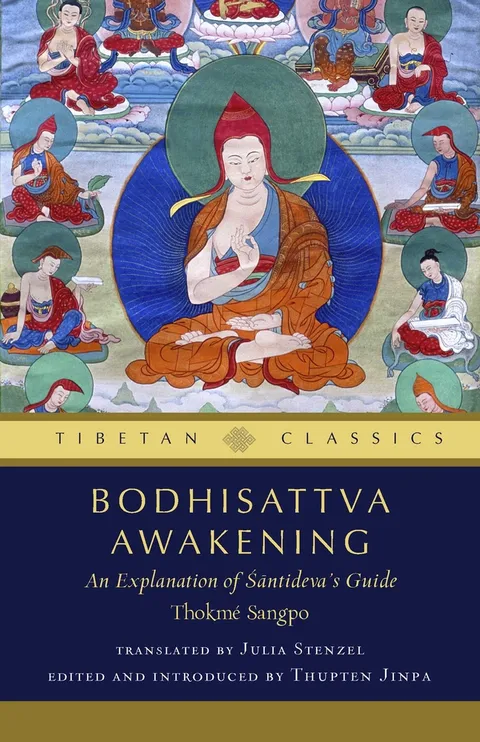
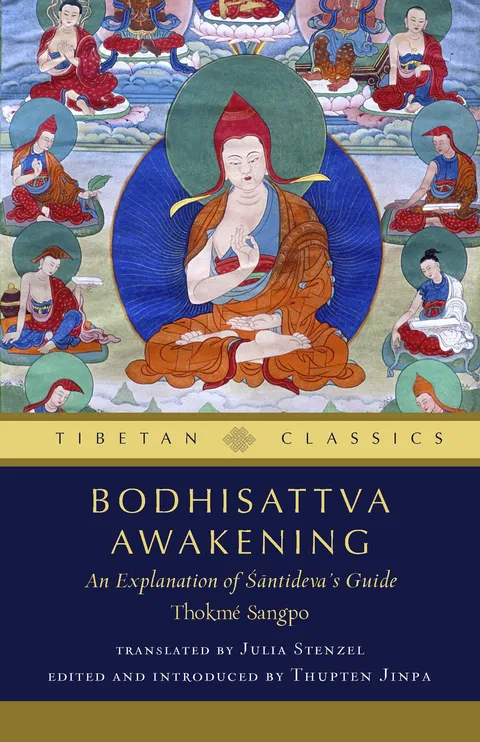
A beloved Tibetan master of the fourteenth century explains the most celebrated guide to Mahayana Buddhist practice.
The Tibetan master Thokme Sangpo (1295–1369) is revered by all schools of Tibetan Buddhism, who usually refer to him with the honorific Gyalse, meaning “bodhisattva,” for his deep devotion to the bodhisattva ideal. He is most known for his Thirty-Seven Practices of Bodhisattvas, a short verse text frequently taught by the Dalai Lama and other teachers as a succinct guide to the path of enlightened altruism. But Thokme Sangpo’s commentary on Shantideva’s famous Guide to the Bodhisattva Way is also a classic of Tibetan literature. With many English translations, the seventh-century Guide is quoted more than any other work for its poetic distillations of key Buddhist truths. And when Tibetan lamas give teachings on the Guide, they consult Thokme Sangpo.
Thokme Sangpo walks readers through Shantideva’s ten chapters of verses with brisk prose explanations organized in a detailed thematic outline. From the inspiring early chapters extolling the bodhisattva’s vast aspirations, through the practice of the six perfections aimed at realizing transcendent wisdom, this first-ever English translation will inspire as it illuminates and deepens readers’ appreciation for one of Buddhism's greatest contributions to world literature. Thupten Jinpa’s introduction unpacks key features of the so-called bodhisattva ideal and provides details about the life of Thokme Sangpo and his place in the Tibetan imagination.
Thokme Sangpo
Trained and ordained in the Sakya school of Tibetan Buddhism, Thokme Sangpo (1295-1369) was also an important custodian and transmitter of the instructions of the Kadam school, with his writings focusing on the Indian treatises on the bodhisattva ideal and on the Tibetan tradition of mind training (lojong). He is said to have composed 115 works, he served as abbot of Bodong E Monastery for nine years, and his masters included Buton, and he trained figures such as Rendawa. Much of his later life was spent in seclusion.
Julia Stenzel
Translated by
Julia Stenzel is an assistant professor at Rangjung Yeshe Institute, Centre for Buddhist Studies of Kathmandu University, Nepal. She received her PhD from McGill University, Montreal. Her research focuses on cross-cultural transformation processes of Buddhist contemplative traditions and their relevance in today's world. Julia examined compassion meditations in Indian and Tibetan contexts and their secular application in contemporary secular settings. Her publications include The Sciencization of Compassion (Springer, 2020) and Buddhist Monasteries of the Thai Forest Tradition in Ontario (Wilfried Laurier Press, 2015).


Why Readwise Books?
Readwise Books is an ebook & audiobook platform that automatically logs how much you and your friends read, making it fun and easy to read more. Learn more →