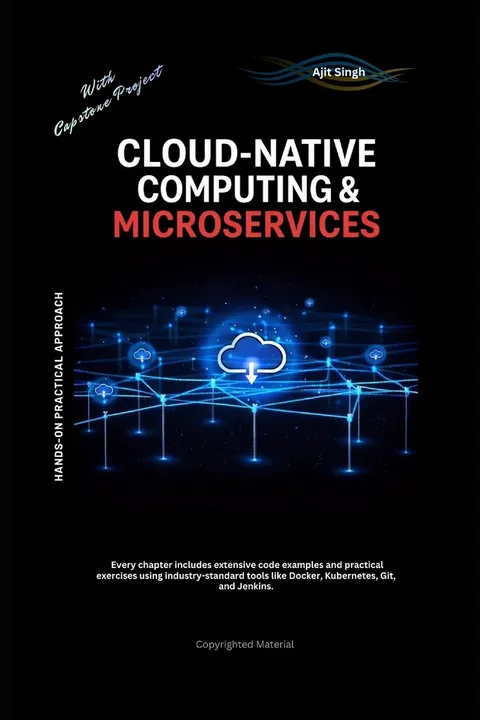
Cloud-Native Computing & Microservices
Report an issue
Tell us what's wrong and we'll take a look.
Thanks – we got it. We'll review and follow up if needed.
Philosophy: Engineering over Abstraction
The core philosophy of this book is "Practical Implementation over Abstract Theory." I operate on the principle that cloud-native development is an engineering discipline that is best learned by building. While understanding the "why" is important, my primary focus is on the "how." Every concept is introduced with the immediate goal of applying it to a tangible problem. I eschew long, theoretical monologues in favour of direct, step-by-step instructions, code snippets, and architectural diagrams that translate concepts into concrete implementations. This book treats microservices not as an academic curiosity, but as a practical solution to the challenges of building scalable, resilient, and maintainable software.
Key Features
1. Strictly 10-Chapter Structure: A concise and focused structure ensures a clear learning path without overwhelming the reader.
2. Hands-On Labs and Code: Every chapter includes extensive code examples and practical exercises using industry-standard tools like Docker, Kubernetes, Git, and Jenkins.
3. Industry-Relevant Tech Stack: The book uses a modern, popular technology stack (e.g., Python/Go/Node.js for services, Docker, Kubernetes, Prometheus, REST APIs) that is directly applicable to jobs in the industry.
4. Architectural Blueprints: Provides clear diagrams and explanations for common cloud-native patterns, helping students understand system design at a high level before diving into code.
5. Beginner to Advanced Progression: The book starts with fundamental concepts, making it accessible to undergraduates, and progresses to advanced topics like service meshes and distributed tracing, providing value for postgraduate students and professionals.
6. Complete Capstone Project: A full, working DIY project in the final chapter, including all source code and step-by-step deployment instructions.
Key Takeaways
Upon completing this book, the reader will be able to:
1. Design and Architect distributed systems using microservices principles.
2. Develop, Test, and Debug individual microservices independently.
3. Containerise any application using Docker and manage container images.
4. Deploy and Orchestrate complex applications on Kubernetes.
5. Implement robust inter-service communication using APIs and an API Gateway.
6. Manage data persistence in a distributed microservices environment.
7. Automate the build, test, and deployment process using a CI/CD pipeline.
8. Monitor, Log, and Trace applications to ensure reliability and observability.
9. Apply fundamental security principles to a cloud-native system.
10. Build a complete, end-to-end cloud-native application from scratch.
Disclaimer: Earnest request from the Author.
Kindly go through the table of contents and refer kindle edition for a glance on the related contents.
Thank you for your kind consideration!



Why Readwise Books?
Readwise Books is an ebook & audiobook platform that automatically logs how much you and your friends read, making it fun and easy to read more. Learn more →