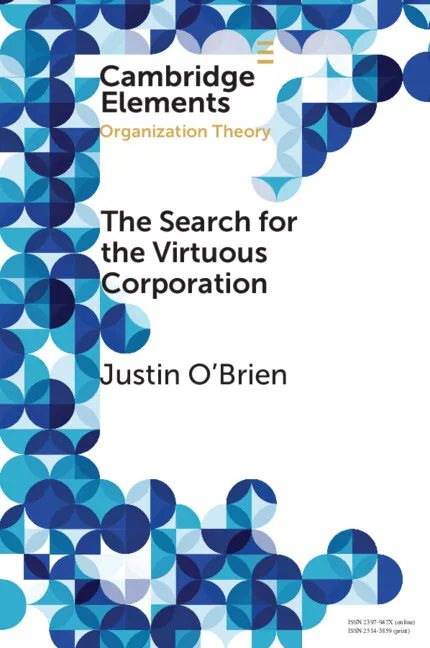
The Search for the Virtuous Corporation
Report an issue
Tell us what's wrong and we'll take a look.
Thanks – we got it. We'll review and follow up if needed.
The corporation is the most complex, adaptive, and resilient model of organizing economic activity in history. In an era of globalization, the transnational corporation has significant power over society. While its rights are specified through private ordering, and choice of jurisdictional home, in the event of conflict of laws, the corporation's duties and responsibilities remain contested. Notwithstanding the argument in institutional economics that all transactions take place within governance and legal frameworks, underpinned by a 'non-calculative social contract, ' the terms are notoriously difficult to define or enforce. They are made more so if regulatory dynamics preclude litigation to a judicial conclusion. This Element situates the corporation - its culture, governance, responsibility, and accountability - within a broader discourse of duty. In doing so, it addresses the problem of the corporation for society and the corporation's problem in aligning its governance to changing community expectations of obligation.
Justin O'Brien
Justin O'Brien is a psychologist, academic and AI consultant. He has spent more than three decades in academic research and teaching at London universities, following a PhD in visual perception at University College London. His work has increasingly focused on the use of data and artificial intelligence to understand the operation and finances of higher education. His 2026 report The 2026 Reckoning analysed the financial position of 150 UK universities and has been downloaded more than 8,000 times. Regulated to Fail develops that work into a broader examination of the financial, regulatory and policy structures that have shaped British higher education.
More by Justin O'Brien




Why Readwise Books?
Readwise Books is an ebook & audiobook platform that automatically logs how much you and your friends read, making it fun and easy to read more. Learn more →