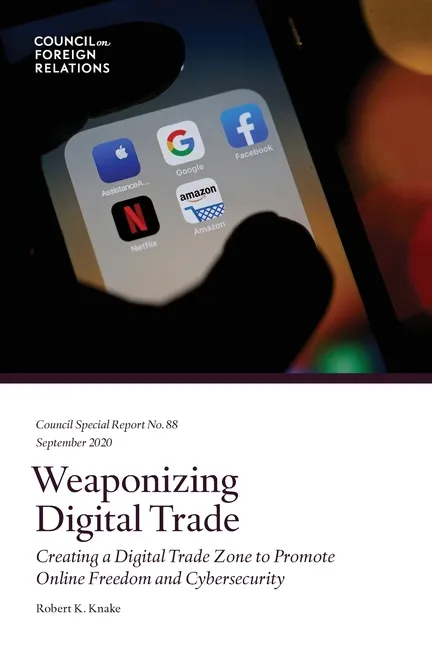
Weaponizing Digital Trade
Report an issue
Tell us what's wrong and we'll take a look.
Thanks – we got it. We'll review and follow up if needed.
"More and more countries are being drawn into the Chinese model of state-controlled networks that limit privacy, build in the capacity for censorship, and provide the backbone for the surveillance state," Knake explains. By forming a digital trade zone among democracies, "the United States and its allies can create a compelling alternative to the authoritarian web," he writes.
The author makes a number of recommendations for the U.S. government to create a digital trade zone, including:
- Establish a treaty organization to coordinate cybersecurity and law enforcement efforts. "Working with Canada and Mexico, the United States could establish such an organization under the auspices of USMCA [United States-Mexico-Canada Agreement], work out its functions, and then seek to draw in other countries to participate."
- Create a shared tariff and sanctions policy. "Trade zone members should agree to jointly sanction nonmember states that harbor cybercriminals or participate in banned activities."
- Create sustained funding for collective efforts. "The agreement should require each member state to contribute annual payments to the treaty organization."
- Involve nongovernmental stakeholders. "For the digital trade zone to achieve its goals, individual and corporate user groups, internet service providers, content service providers, software and hardware makers, and cybersecurity companies will all need to be involved."
- Clean up the open web. "A crucial part of this effort should be a sustained, coordinated effort to dismantle the infrastructure used by cybercriminals."
- Table the hardest issues. "Certain complicated issues in internet governance are unlikely to be resolved by trade negotiators and should be tabled to prevent stalling the formation of the trade zone."
"The United States has a short window to draw Europe in and create a competing vision that would attract fence-sitters such as Brazil, India, and Indonesia, which have democratic traditions and are wary of Chinese hegemony on the web," warns Knake. "By tying access to the digital trade zone to obligations for cybersecurity, privacy, and law enforcement cooperation . . . the United States and its allies can force countries to choose between access to their markets or tight control of the internet in the Chinese model."
"Securing an open, interoperable, secure, and reliable internet against threats from authoritarian regimes will likely require abandoning hope that such a network can be global," concludes Knake.
Robert K Knake
Robert K. Knake is a senior fellow at the Council on Foreign Relations, a senior research scientist at Northeastern University, and an adviser to startups, investment firms, and Fortune 500 companies. Knake served from 2011-15 in the Obama White House as director for cybersecurity policy at the National Security Council. He is coauthor (with Richard A. Clarke) of the New York Times bestseller Cyber War.
More by Robert K Knake


Why Readwise Books?
Readwise Books is an ebook & audiobook platform that automatically logs how much you and your friends read, making it fun and easy to read more. Learn more →