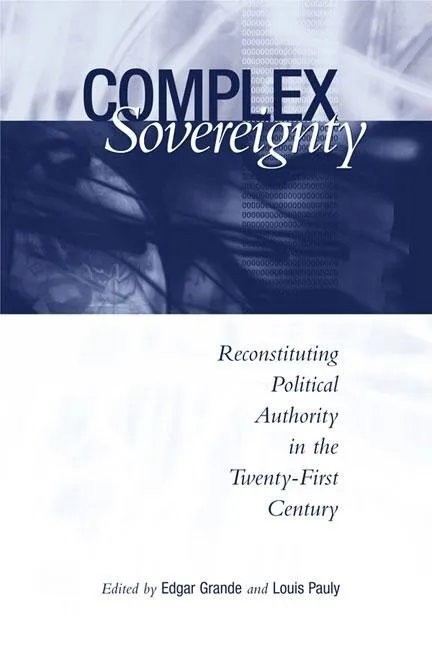
Complex Sovereignty
Reconstituting Political Authority in the Twenty-First Century
Report an issue
Tell us what's wrong and we'll take a look.
Thanks – we got it. We'll review and follow up if needed.
The way humanity governs itself is today changing very rapidly. Profound transformations in structures of political authority are underway in Europe, North America, and beyond. Nation-states remain central, but they cannot address the most pressing problems facing their own citizens without moving away from traditional understandings of sovereignty itself. Complex Sovereignty contends that just such a movement is underway.
Editors Edgar Grande and Louis W. Pauly and the contributors to this volume elucidate the meaning of 'complex sovereignty' through a set of conceptual and empirical studies including governance in the European Union and North America, the emergence of private-public partnerships, the adaptation of established international organizations, and the search for innovative mechanisms to manage risk. They reveal a fascinating and vitally important struggle to give coherence to a complicated governing system of multiple and overlapping hierarchies. This is an original, collaborative study crossing the disciplines of political science, international relations, sociology, and political economy.
Edgar Grande
Edgar Grande is a professor of political science at the University of Munich.
Louis W Pauly
Louis W. Pauly is a J. Stefan Dupré Distinguished Professor of Political Economy in the Department of Political Science and the Munk School of Global Affairs & Public Policy at the University of Toronto. He is a Fellow of the Royal Society of Canada and a recipient of the Distinguished Scholar Award in International Political Economy from the International Studies Association. Publications include Opening Financial Markets (1988), Who Elected the Bankers? (1997), The Myth of the Global Corporation (1998), and Complex Sovereignty (2005).


Why Readwise Books?
Readwise Books is an ebook & audiobook platform that automatically logs how much you and your friends read, making it fun and easy to read more. Learn more →