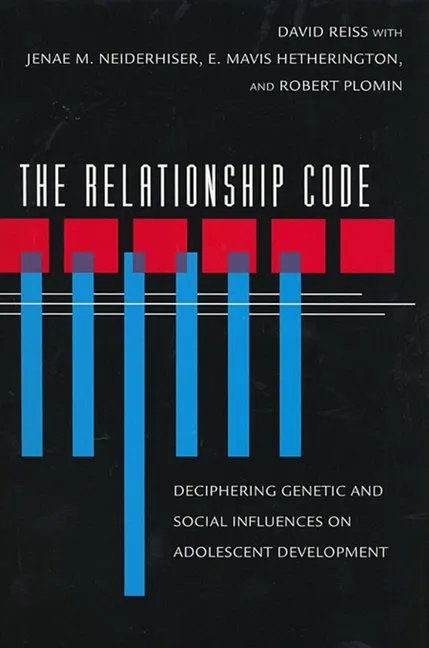
The Relationship Code
Deciphering Genetic and Social Influences on Adolescent Development
Report an issue
Tell us what's wrong and we'll take a look.
Thanks – we got it. We'll review and follow up if needed.
The Relationship Code is the report of a longitudinal study, conducted over a ten-year period, of the influence of family relationships and genetic factors on competence and psychopathology in adolescent development. The sample for this landmark study included 720 pairs of same-sex adolescent siblings--including twins, half siblings, and genetically unrelated siblings--and their parents.
Using a clear expressive style, David Reiss and his coinvestigators identify specific mechanisms that link genetic factors and the social environment in psychological development. They propose a striking hypothesis: family relationships are crucial to the expression of genetic influences on a broad array of complex behaviors in adolescents. Moreover, this role of family relationships may be very specific: some genetic factors are linked to mother-child relationships, others to father-child relations, some to relationship warmth, while others are linked to relationship conflict or control. The specificity of these links suggests that family relationships may constitute a code for translating genetic influences into the ontogeny of behaviors, a code every bit as important for behavior as DNA-RNA.









Why Readwise Books?
Readwise Books is an ebook & audiobook platform that automatically logs how much you and your friends read, making it fun and easy to read more. Learn more →