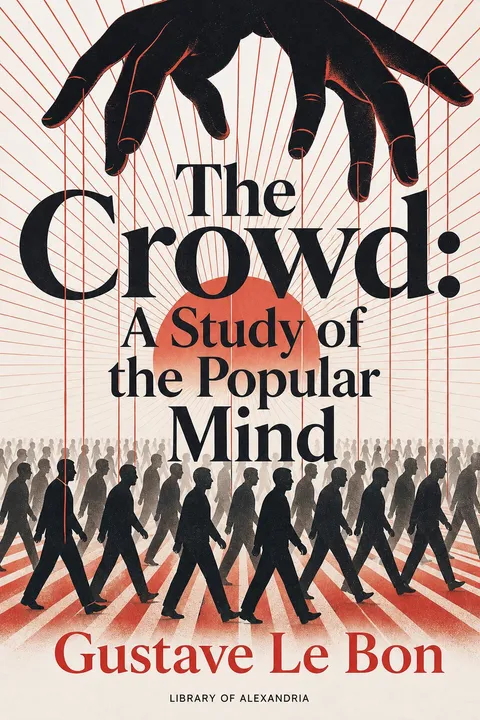
The Crowd: A Study of the Popular Mind
Mass Psychology and Collective Behavior in an Age of Persuasion
Report an issue
Tell us what's wrong and we'll take a look.
Thanks – we got it. We'll review and follow up if needed.
How does a gathering of individuals become a force that thinks and acts as one? Gustave Le Bon explores the emotions, beliefs, and leaders that turn people into a crowd.
First published in 1895, The Crowd: A Study of the Popular Mind offers an influential account of mass psychology. Le Bon argues that individuals within a crowd can lose their habitual restraint and independence, becoming unusually receptive to suggestion and shared emotion. His inquiry ranges across political movements, religious conviction, and collective action, asking why a group may embrace conduct its members would resist alone.
At the heart of the book is the power of persuasion: vivid images, repeated assertions, prestige, and deeply held beliefs can move people more effectively than reasoned argument. Le Bon examines both the destructive impulses and the courage or self-sacrifice he attributes to crowds. Read as a historical theory rather than a settled scientific explanation, his work remains a provocative lens for considering public opinion and the relationship between leaders and followers.
What readers find inside:
- Collective behavior - Le Bon considers how participation in a crowd can alter individual judgment and conduct.
- Emotional contagion - Shared feelings and suggestion help explain the rapid spread of conviction within groups.
- Persuasive leadership - Prestige, affirmation, and repetition play central roles in his account of influence.
- Images and beliefs - The book explores why symbols and compelling ideas can outweigh logical argument.
- Political crowds - Discussions of electoral gatherings and parliamentary assemblies extend the argument beyond the street.
This book will appeal to readers of social psychology, students of political thought, and anyone interested in the history of persuasion. Its nineteenth-century assumptions invite critical reading alongside its enduring questions about group influence.
Begin with the question of what changes when people cease to act alone.
Gustave Le Bon
Gustave Le Bon (May 7, 1841-Dec. 13, 1931) was born in France. He was a French social psychologist and is most famous for his study of the psychological characteristics of crowds. After being rewarded with a doctorate in medicine, Le Bon went to Europe, North Africa, and Asia and wrote many books on anthropology and archaeology. His interests turned toward natural science and social psychology. In Les Lois's psychologiques de l'évolution des peuples (1894), he improved a view that history is the product of culture or national character, with feelings, not intelligence. Le Bon accepted that modern life was progressively described by crowd assemblages. In La Psychologie des Foules (1895), (The Crowd), his most famous work, he argued that the mindful personality of the person in a crowd is immersed and that the collective crowd mind rules; crowd behavior is united, emotional, or psychologically weak.
More by Gustave Le Bon




Why Readwise Books?
Readwise Books is an ebook & audiobook platform that automatically logs how much you and your friends read, making it fun and easy to read more. Learn more →