Report an issue
Tell us what's wrong and we'll take a look.
Thanks – we got it. We'll review and follow up if needed.
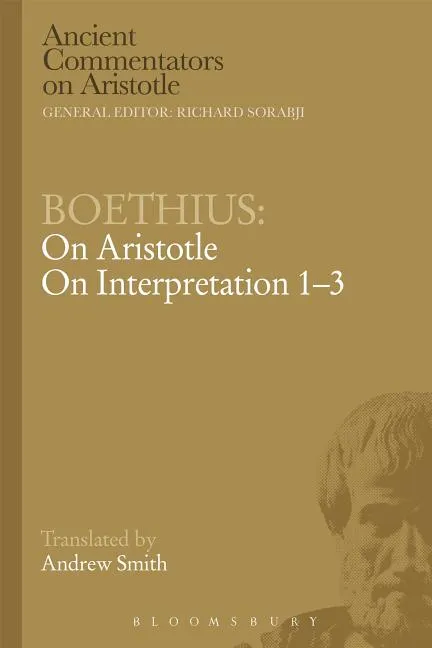
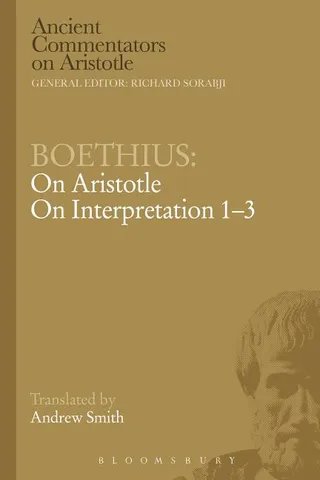
Boethius (c.480-c.525) wrote his highly influential second commentary on Aristotle's On Interpretation in Latin, but using the style of the Greek commentaries on Aristotle. It was part of his project to bring knowledge of Plato and Aristotle to the Latin-speaking world of his fellow Christians. The project was cruelly interrupted by his execution at the age of about 45, leaving the Latin world under-informed about Greek Philosophy for 700 years. Boethius reveals to us how On Interpretation was understood not only by himself, but also by some of the best Greek interpreters, especially Alexander and Porphyry. Alexander had insisted that its subject was composite thoughts, not composite sentences nor composite things - it is thoughts that are primarily true or false. Although Aristotle's first six chapters define name, verb, sentence, statement, affirmation and negation, Porphyry had claimed that Aristotelians believe in three types of name and verb, written, spoken and mental, in other words a language of the mind.
Boethius discusses individuality and ascribes to Aristotle a view that each individual is distinguished by having a composite quality that is not merely unshared, but unshareable. Boethius also discusses why we can still say that the dead Homer is a poet, despite having forbidden us to say that the dead Socrates is either sick or well. But Boethius' most famous contribution is his interpretation of Aristotle's discussion of the threat of that tomorrow's events, for example a sea battle, will have been irrevocable 10,000 years ago, if it was true 10,000 years ago that there would be a sea battle on that day. In Boethius' later Consolation of Philosophy, written in prison awaiting execution, he offered a seminal conception of eternity to solve the related problem of future events being irrevocable because of God's foreknowledge of them.
Boethius' influential commentary was part of his ideal of bringing Plato and Aristotle to the Latin-speaking world. Throughout the Latin Middle Ages, it remained the standard introduction to On Interpretation.
This volume contains the first English translation of Boethius' commentary, as well as a detailed introduction, notes and bibliography.






Why Readwise Books?
Readwise Books is an ebook & audiobook platform that automatically logs how much you and your friends read, making it fun and easy to read more. Learn more →