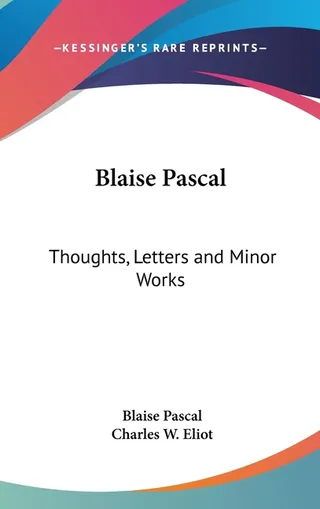
Thoughts, Letters & Minor Works
The Five Foot Shelf of Classics, Vol. XLVIII (in 51 Volumes)
Report an issue
Tell us what's wrong and we'll take a look.
Thanks – we got it. We'll review and follow up if needed.
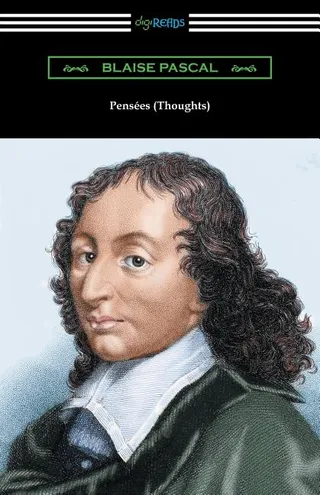
Translator names not noted above: Mary L. Booth and Orlando W. Wight. Originally published between 1909 and 1917 under the name "Harvard Classics," this stupendous 51-volume set-a collection of the greatest writings from literature, philosophy, history, and mythology-was assembled by American academic CHARLES WILLIAM ELIOT (1834-1926), Harvard University's longest-serving president. Also known as "Dr. Eliot's Five Foot Shelf," it represented Eliot's belief that a basic liberal education could be gleaned by reading from an anthology of works that could fit on five feet of bookshelf. Volume XLVIII features three collections of the writings of French polymath BLAISE PASCAL (1623-1662): Thoughts, considered a great classic of religious writings, in which the former child prodigy mounts a sophisticated defense of his Catholic faith; Letters, to his friends and family as well as to the Swedish queen Christina; and Minor Works, including "Prayer, to Ask of God the Proper Use of Sickness," "Discourses on the Condition of the Great," "The Art of Persuasion," and more.
Louis de Montalte
The author of The Arimathea Protocol writes under a historically significant pseudonym, choosing to let the intersection of science, theology, and deep history speak for itself. Raised in an austere, traditional environment on an old German farm, living without running water or electricity well into the 1970s, the author developed an early, profound appreciation for contemplation. This upbringing forged a life guided by a singular mantra: Intention is the enemy of entropy. Following a diverse career spanning military service, a decade in the non-profit sector, and two decades supplying the nuclear, energy and defense industries, the author undertook what he calls "Pascal's Challenge." Taking 60 days of solitude to confront the deep fractures between modern science and faith, he sought a reconciliation once shared by intellectual giants like Newton, Kepler, and Pascal. The author's extensive theological studies, began with a strong Catholic foundation, and included time under the late theologian R.C. Sproul, and his deep fascination with "the thermodynamics of sanctification" heavily inform his debut novella. The Arimathea Protocol masterfully blends meticulous first-century history, traditional theology, and ancient lore into a fast-paced narrative exploring the "silent years" of the Holy Family. When not exploring how to outmaneuver entropy, the author is an avid culinary enthusiast who has spent decades learning alongside elite chefs. He continues to write from his home in the United States, exploring the hidden gears of history and faith.
More by Louis de Montalte




Why Readwise Books?
Readwise Books is an ebook & audiobook platform that automatically logs how much you and your friends read, making it fun and easy to read more. Learn more →