
Report an issue
Tell us what's wrong and we'll take a look.
Thanks – we got it. We'll review and follow up if needed.
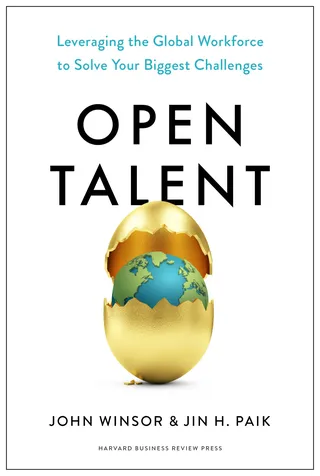
In the new world of hybrid work and AI, one thing is clear: the war for talent is over--and talent won.
With sparsely populated offices and people working from wherever they are, and with AI emerging everywhere in business and dominating headlines, our work lives have undergone a remarkable transformation, seemingly overnight. But the reality is that for years the ever-growing digital wave has been breaking down organizational boundaries and increasing the adoption of open innovation, including the use of crowdsourcing platforms as a talent solution. Now the imperative is clear: adapt to and leverage this new, digitally enabled world of "open talent"--or get left behind.
In this eye-opening, essential guidebook, John Winsor and Jin Paik, with their work at the Laboratory for Innovation Science at Harvard, show how the massive reset of the pandemic allowed talented workers everywhere to exit their jobs without leaving the workforce. Now many are freelancing for multiple companies or are starting small businesses, challenging hiring managers as never before amidst a transformed workforce. What's more, talent has more power than ever using platforms such as Freelancer.com, Fiverr, and Upwork, setting their own terms for work: what, where, when, and at what price.
How can companies adapt? The key, the authors argue, is shifting to a more distributed idea and structure of collaborative work. The authors call this a networked organization, where talent is culled from both inside and outside the organization and viewed through a single lens--as a global ecosystem that can be tapped as needed.
With rich stories, keen insights, and an abundance of practical advice, Winsor and Paik provide a new framework and operating model for transforming your organization into a talent-orchestrating, problem-solving machine.


Jin H Paik
Jin H. Paik builds talent models and disruptive technology. He has worked at the intersection of digital transformation, data science and artificial intelligence, and the future of work over the past decade in academia and industry. Currently, he is a research scientist at Harvard Business School and is a cofounder and managing partner of Altruistic, a data science consultancy with a crowd of 3,000 experts and a technology development platform. He was the head of labs at the Data, Digital, and Design Institute at Harvard, where he developed the institute's strategic vision and directed project and research activities. Previously, he was the founding general manager and senior researcher at the Laboratory for Innovation Science at Harvard, where he oversaw the development of open innovation programs with NASA, Harvard Medical School, Broad Institute, and other companies, including the execution of 800-plus innovation projects. He has taught in-person and online courses at Harvard. He holds a bachelor's degree from the University of Michigan and a master's degree from Harvard, and he is a doctoral candidate at New York University, investigating innovation and leadership in organizations.


Why Readwise Books?
Readwise Books is an ebook & audiobook platform that automatically logs how much you and your friends read, making it fun and easy to read more. Learn more →