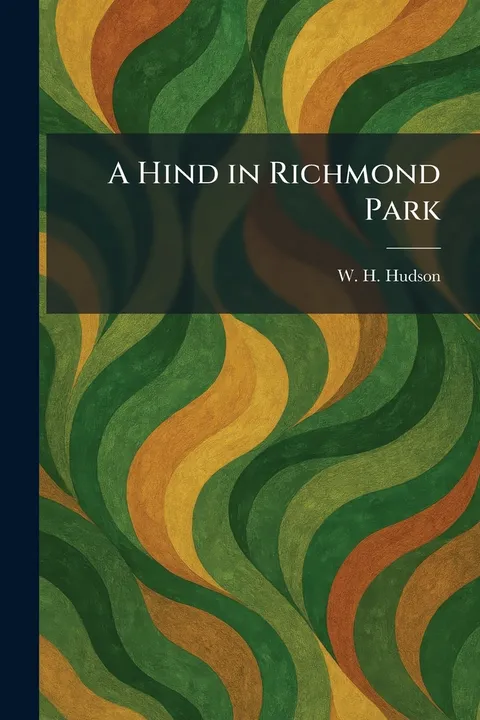
A Hind in Richmond Park
Report an issue
Tell us what's wrong and we'll take a look.
Thanks – we got it. We'll review and follow up if needed.
"A Hind in Richmond Park" is a profound and wandering meditation on the natural world, representing the final literary legacy of the renowned naturalist W. H. Hudson. Beginning with a chance encounter with a red deer in London's Richmond Park, the narrative quickly expands into a vast exploration of the sensory lives of animals and humans alike. Hudson delves into diverse topics such as the mystery of bird migration, the atmospheric influence of wind, the origins of music, and the subtle "sixth sense" that links living beings to their environment.
Combining keen scientific observation with a poetic, philosophical sensibility, the work reflects Hudson's lifelong devotion to understanding the intricacies of the wild. It captures his unique ability to find universal truths in the smallest details of the landscape, offering readers a contemplative journey through biology, psychology, and the aesthetic beauty of the outdoors. As a masterpiece of early 20th-century nature writing, "A Hind in Richmond Park" remains a vital text for those interested in the deep connections between humanity and the earth's non-human inhabitants.
This work has been selected by scholars as being culturally important, and is part of the knowledge base of civilization as we know it. This work was reproduced from the original artifact, and remains as true to the original work as possible. Therefore, you may see the original copyright references, library stamps (as most of these works have been housed in our most important libraries around the world), and other notations in the work.
This work is in the public domain in the United States of America, and possibly other nations. Within the United States, you may freely copy and distribute this work, as no entity (individual or corporate) has a copyright on the body of the work.
As a reproduction of a historical artifact, this work may contain missing or blurred pages, poor pictures, errant marks, etc. Scholars believe, and we concur, that this work is important enough to be preserved, reproduced, and made generally available to the public. We appreciate your support of the preservation process, and thank you for being an important part of keeping this knowledge alive and relevant.
W H Hudson
W. H. Hudson was a British biologist, ornithologist, and author who lived from 1841 to 1922. Hudson, who was born in Argentina to British parents, spent a large portion of his youth travelling and learning about the flora and animals of South America. In his early twenties, he came to England and took a job as a clerk. Despite this, he continued to write about nature and in 1892, "The Naturalist in La Plata," his first book, was published. After that, Hudson published numerous other books about the natural environment, including "British Birds" and "Idle Days in Patagonia." He is most well-known, however, for his books, including "Green Mansions" and "The Purple Land," which merged his love of the outdoors with his prowess as a writer. The grandeur and mystique of the wilderness were beautifully and evocatively captured in Hudson's writing, which was praised for its in-depth and evocative depictions of the natural environment. He was also a forerunner in the conservation movement and a proponent of preserving endangered species' habitats.
More by W H Hudson



Why Readwise Books?
Readwise Books is an ebook & audiobook platform that automatically logs how much you and your friends read, making it fun and easy to read more. Learn more →