Report an issue
Tell us what's wrong and we'll take a look.
Thanks – we got it. We'll review and follow up if needed.
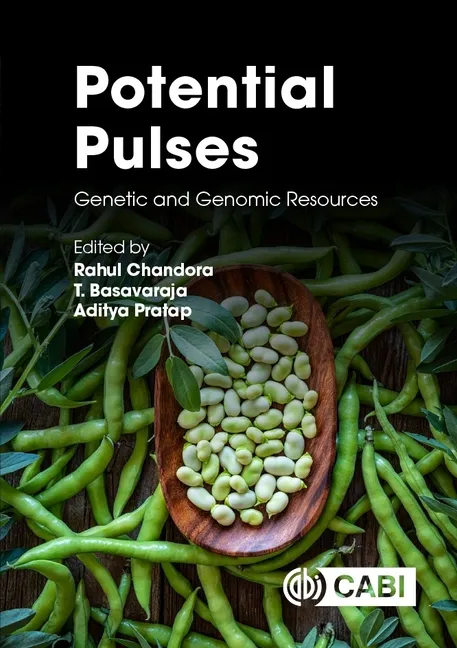
The fight against global hunger demands a fresh perspective. Lesser-known legumes, often called 'potential pulses', can play a pivotal role. These underutilized powerhouses, including adzuki bean, bambara groundnut, faba bean, cowpea, grass pea and horse gram, among others, are currently untapped resources. Their potential goes beyond their ability to thrive in harsh environments (caused by high temperature, drought, etc.) and fix nitrogen. With increased understanding of these legumes and their genetic and genomic potential, we can unlock a new world of sustainable and nutritious food sources. This book explores: The rich genetic diversity of potential pulses and its role in resilience. How advanced genomics can identify traits for improved yields, pest resistance, and climate adaptation. Strategies for conserving and utilizing these valuable genetic resources. Breeding programmes harnessing genetic potential to create next-generation pulse varieties. Focusing on the untapped genetic and genomic potential of these legumes, this book empowers researchers, breeders, and policymakers to unlock a new era of food and nutritional security. By leveraging the power of their genes, we can transform underutilized pulses into the nutritional heroes of tomorrow.
Rahul Chandora
Dr. Rahul Chandora is working as a Scientist (Senior Scale) at the ICAR-National Bureau of Plant Genetic Resources, Regional Station, Shimla. He has been serving as the curator of potential crops (adzuki bean, rice bean, amaranth, buckwheat, and chenopod) and is involved in the Plant Genetic Resource (PGR) management of legumes & pseudocereals which includes germplasm augmentation, characterization, evaluation (screening against biotic stresses, molecular, nutritional profiling), conservation as well as documentation and database curation for storage. He is trained in the use of molecular and bioinformatic techniques in plant genetics. He is the main developer of two varieties (one variety of Quinoa, 'Him Shakti' and one variety of Buckwheat, 'Him Phaphra') that were released and notified by the CVRC (Central Sub-Committee on Crop Standards Notification and Release of Varieties) in 2021. Him Shakti is the first variety of quinoa to be released in India. He has also established two Community Seed Banks (CSBs) in Himachal Pradesh, India. It is also worth noting that he was a part of the team that identified and registered two genetic stocks, INGR21103 & INGR21136 of French bean that are resistance to Bean Common Mosaic Virus. He is also handling various institutional and externally-funded projects as Principal Investigator and Co-Principal Investigator.
T Basavaraja
Dr. Basavaraja, T. started his career as a Scientist at the ICAR- Indian Institute of Pulses Research, Kanpur-208024 (India). He has seven-year of research experience in grain legume genetics and breeding and gained extensive conceptual knowledge in the diverse domain of Genetics, Cytogenetics, Crop Breeding, Population genetics, and Crop Biotechnology. Presently, He is working on genetic enhancement of pulse crops such as Common bean and Mung bean. He was an associated breeder and developer for developing high-yielding high yielding mung bean cultivars viz., IPM 512-1 (Soorya), IPM 312-20 (Vasudha) & IPM 409-4 (Heera). He procured and collected more than 2000 germplasm accessions of common bean from national & international gene banks. He contributed to the development of eight genetic stocks (4, common bean & 4, Mung bean) for BCMV disease resistance, yellow seeded & Bruchid resistance. He is actively working as a project leader in two externally funded projects (the DST-SERB project and Alliance Bioversity International-CIAT Common bean project). For his remarkable contribution to agricultural science, he received a young scientist award in the scientist award ceremony at Lucknow University (Uttar Pradesh).


Why Readwise Books?
Readwise Books is an ebook & audiobook platform that automatically logs how much you and your friends read, making it fun and easy to read more. Learn more →