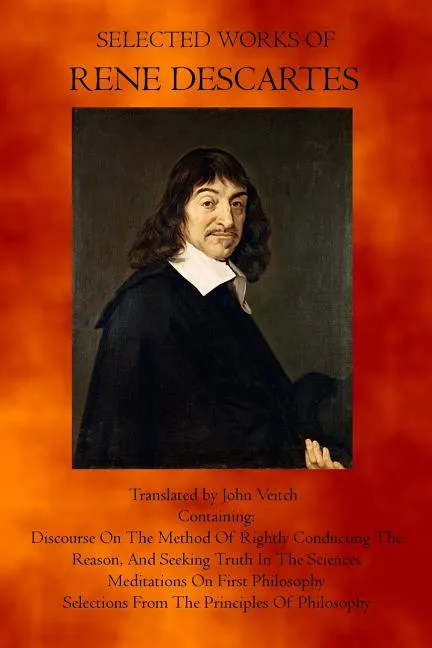
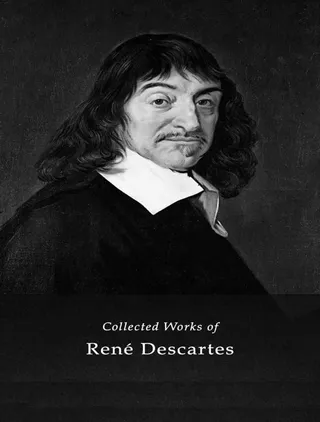
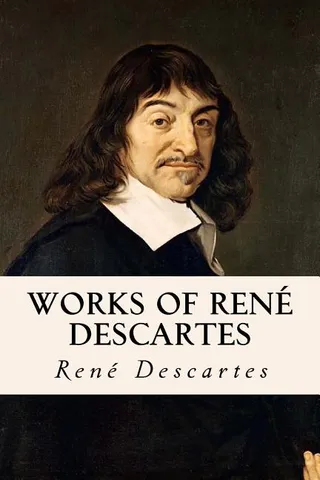
Selected Works of Rene Descartes
Report an issue
Tell us what's wrong and we'll take a look.
Thanks – we got it. We'll review and follow up if needed.
Thank you for checking out this book by Theophania Publishing. We appreciate your business and look forward to serving you soon. We have thousands of titles available, and we invite you to search for us by name, contact us via our website, or download our most recent catalogues. René Descartes was a French philosopher and writer who spent most of his adult life in the Dutch Republic. He has been dubbed the 'Father of Modern Philosophy', and much subsequent Western philosophy is a response to his writings, which are studied closely to this day. In particular, his Meditations on First Philosophy continues to be a standard text at most university philosophy departments. Descartes's influence in mathematics is equally apparent; the Cartesian coordinate system, allowing geometric shapes to be expressed in algebraic equations, was named after him. He is credited as the father of analytical geometry. Descartes was also one of the key figures in the Scientific Revolution. Descartes frequently sets his views apart from those of his predecessors. In the opening section of the Passions of the Soul, a treatise on the Early Modern version of what are now commonly called emotions, Descartes goes so far as to assert that he will write on this topic "as if no one had written on these matters before". Many elements of his philosophy have precedents in late Aristotelianism, the revived Stoicism of the 16th century, or in earlier philosophers like St. Augustine. In his natural philosophy, he differs from the Schools on two major points: First, he rejects the analysis of corporeal substance into matter and form; second, he rejects any appeal to ends, divine or natural, in explaining natural phenomena. In his theology, he insists on the absolute freedom of God's act of creation. Descartes was a major figure in 17th century continental rationalism, later advocated by Baruch Spinoza and Gottfried Leibniz, and opposed by the empiricist school of thought consisting of Hobbes, Locke, Berkeley, Jean-Jacques Rousseau, and Hume. Leibniz, Spinoza and Descartes were all well versed in mathematics as well as philosophy, and Descartes and Leibniz contributed greatly to science as well. As the inventor of the Cartesian coordinate system, Descartes founded analytic geometry, the bridge between algebra and geometry, crucial to the discovery of infinitesimal calculus and analysis. He is perhaps best known for the philosophical statement "Cogito ergo sum" (French: Je pense, donc je suis; English: I think, therefore I am; or I am thinking, therefore I exist or I do think, therefore I do exist), found in part IV of Discourse on the Method.
Rene Descartes
René Descartes, known as the Father of Modern Philosophy and inventor of Cartesian coordinates, was a seventeenth century French philosopher, mathematician, and writer. Descartes made significant contributions to the fields of philosophy and mathematics, and was a proponent of rationalism, believing strongly in fact and deductive reasoning. Working in both French and Latin, he wrote many mathematical and philosophical works including The World, Discourse on a Method, Meditations on First Philosophy, and Passions of the Soul. He is perhaps best known for originating the statement “I think, therefore I am.”
More by Rene Descartes




Why Readwise Books?
Readwise Books is an ebook & audiobook platform that automatically logs how much you and your friends read, making it fun and easy to read more. Learn more →