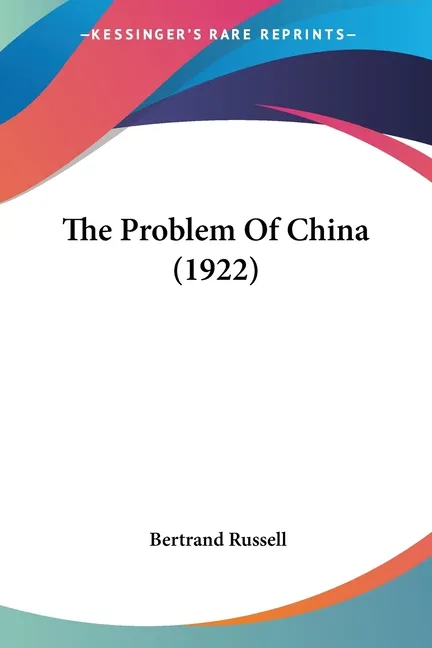
The Problem Of China (1922)
Report an issue
Tell us what's wrong and we'll take a look.
Thanks – we got it. We'll review and follow up if needed.
""The Problem of China"" is a book written by the renowned philosopher and mathematician Bertrand Russell in 1922. In this book, Russell delves into the complex issues surrounding China's political and social situation during the early 20th century. He examines the historical context of China's struggles with modernization, imperialism, and revolution, and offers his own analysis and suggestions for how China might move forward.Russell begins by exploring the various factors that have contributed to China's weakened state, including its isolationist policies, lack of technological development, and political corruption. He then goes on to discuss the impact of Western imperialism on China, particularly the unequal treaties imposed by foreign powers and the resulting economic exploitation.The book also examines the rise of revolutionary movements in China, including the Communist Party and the Kuomintang, and their respective ideologies. Russell offers his own critique of both movements, arguing that while communism may offer a solution to China's economic problems, it is unlikely to succeed given the country's cultural and social traditions. On the other hand, he sees the Kuomintang's nationalist vision as more viable, but also notes the challenges it faces in uniting a diverse and divided country.Throughout the book, Russell emphasizes the importance of education and social reform in China's path towards modernization and independence. He also advocates for a more cooperative relationship between China and the West, based on mutual respect and understanding.Overall, ""The Problem of China"" offers a nuanced and insightful analysis of the complex issues facing China during a pivotal moment in its history, and remains a valuable resource for anyone interested in the country's past, present, and future.This scarce antiquarian book is a facsimile reprint of the old original and may contain some imperfections such as library marks and notations. Because we believe this work is culturally important, we have made it available as part of our commitment for protecting, preserving, and promoting the world's literature in affordable, high quality, modern editions, that are true to their original work.
Bertrand Russell
Bertrand Arthur William Russell, 3rd Earl Russell was a British philosopher, logician, mathematician, historian, social reformer, and pacifist. Although he spent the majority of his life in England, he was born in Wales, where he also died. Russell led the British “revolt against Idealism” in the early twentieth century and is one of the founders of analytic philosophy along with his protégé Wittgenstein and his elder Frege. He co-authored, with A. N. Whitehead, Principia Mathematica, an attempt to ground mathematics on logic. His philosophical essay “On Denoting” has been considered a “paradigm of philosophy.” Both works have had a considerable influence on logic, mathematics, set theory, linguistics and analytic philosophy. He was a prominent anti-war activist, championing free trade between nations and anti-imperialism. Russell was imprisoned for his pacifist activism during World War I, campaigned against Adolf Hitler, for nuclear disarmament. He criticized Soviet totalitarianism and the United States of America’s involvement in the Vietnam War. In 1950, Russell was awarded the Nobel Prize in Literature, “in recognition of his varied and significant writings in which he champions humanitarian ideals and freedom of thought.”
More by Bertrand Russell





Why Readwise Books?
Readwise Books is an ebook & audiobook platform that automatically logs how much you and your friends read, making it fun and easy to read more. Learn more →