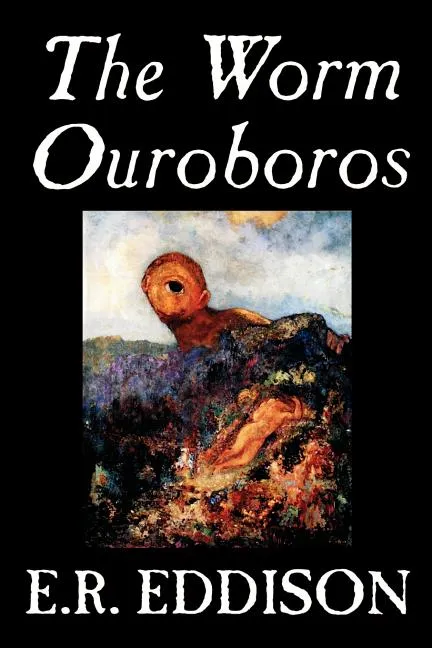
The Worm Ouroboros by E.R. Eddison, Fiction, Fantasy
Report an issue
Tell us what's wrong and we'll take a look.
Thanks – we got it. We'll review and follow up if needed.
THE WORM OUROBOROS, no worm, but the Serpent itself, is a wonderful book. As a story or as prose it is wonderful, and, there being a cause for every effect, the reason for writing it should be as marvelous again. Shelley had to write the Prometheus Unbound, he was under compulsion; for a superhuman energy had come upon him, and he was forced to create a matter that would permit him to imagine, and think, and speak like a god. It was so with Blake, who willed to appear as a man but existed like a mountain; and, at their best, the work of these poets is inhuman and sacred. It does not greatly matter that they had or had not a message. It does not matter at all that either can be charged with nonsense or that both have been called madmen -- the same charge might be laid against a volcano or a thunderbolt -- or this book. It does not matter that they could transcend human endurance, and could move tranquilly in realms where lightning is the norm of speed. The work of such poets is sacred because it outpaces man and in a realm of their own, wins even above Shakespeare.
E R Eddison
E. R. Eddison (1882–1945) was born in Leeds, England, and shared an early education with fellow author Arthur Ransome. Later, after attending Eton and Oxford, Eddison joined the Board of Trade, where he worked until his retirement in 1938. In 1922 Eddison released his most enduring and critically acclaimed work, The Worm Ouroboros, depicting the land of Mercury. Eddison would return to Mercury a decade later with his Zimiamvian trilogy.
More by E R Eddison


Why Readwise Books?
Readwise Books is an ebook & audiobook platform that automatically logs how much you and your friends read, making it fun and easy to read more. Learn more →