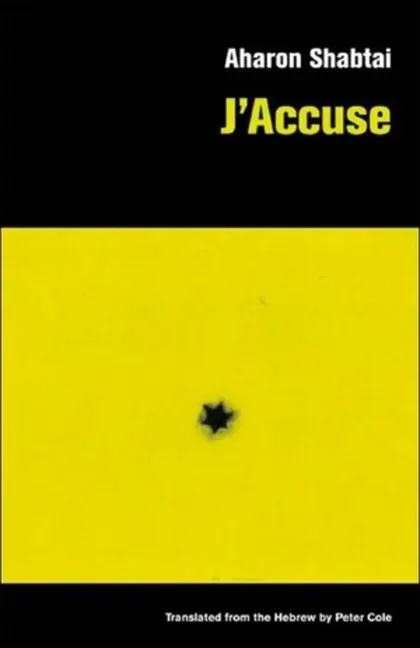
J'Accuse
Report an issue
Tell us what's wrong and we'll take a look.
Thanks – we got it. We'll review and follow up if needed.
Playing on Zola's famous letter denouncing the anti-Semitism of the French government throughout the Dreyfus affair, Aharon Shabtai's title can be taken literally: it charges his government and his people with crimes against the humanity of their neighbors. Here we find snipers shooting children, spin-masters trying to whitewash blood baths, ammunition "distributed like bars of chocolate," and "technicians of slaughter" for whom morality is merely "a pain in the ass."
With a splendid lyrical physicality that accentuates Shabtai's terse immediacy and matter-of-fact scorn, the poems cover a period of six yearsfrom the 1996 election of Netanyahu as prime minister through the curfews, lynchings, riots, sieges, and bombings of the second intifada. But at the heart of J'Accuse is the fate of the ethical Hebrew culture in which the poet was raised: Shabtai refuses to abandon his belief in the moral underpinnings of Israeli society or to be silent before the barbaric and brutal. He witnesses, he protests, he warns. Above all, he holds up a mirror to his nation.
Aharon Shabtai
An Israeli poet born in 1939, and an outspoken critic of his government’s treatment of the Palestinians, Aharon Shabtai is widely viewed as “one of the most exciting writers working in Hebrew today” (Ha’aretz). Author of twenty-three volumes of poetry, he is also the foremost translator of Greek drama into Hebrew. New Directions publishes J’accuse, which received the PEN Translation Prize, as well as War & Love, Love & War, and Requiem & Other Poems.
More by Aharon Shabtai



Why Readwise Books?
Readwise Books is an ebook & audiobook platform that automatically logs how much you and your friends read, making it fun and easy to read more. Learn more →