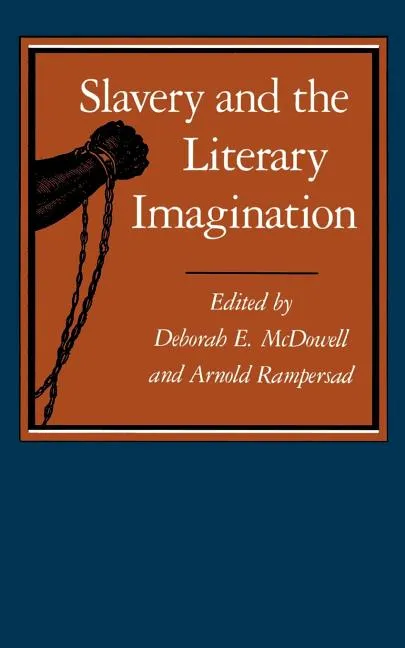
Slavery and the Literary Imagination
Report an issue
Tell us what's wrong and we'll take a look.
Thanks – we got it. We'll review and follow up if needed.
Seven noted scholars examine slave narratives and the topic of slavery in American literature, from Frederick Douglass's Narrative (1845)--treated in chapted by Jamkes Olney and William L. Andrews--to Sherley Anne Williams's Dessa Rose (1984). Among the contributors, Arnold Rampersad reads W.E.B. DuBois's classic work The Souls of Black Folk (1903) as a response to Booker T. Washington's Up from Salvery (1901). Hazel V. Carby examines novels of slavery and novels of sharecropping and questions the critical tendency to comflate the two, thereby also conflating the nineteenth century wiith the twentieth, the rural with the urban.
Although works by Afro-American writers are the primary focus, the authors also examine antislavery novels by white women. Hortense J. Spillers gives extensive attention to Harriet Beecher Stowe's Uncle Tom's Cabin, in juxtaposition with Ishmael Reed's Flight to Canada; Carolyn L. Karcher readers Lydia Maria Child's A Romance of the Republic as an abolitionist vision of America's racial destiny.
In a concluding chapter, Deborah E. McDowell's reading of Dessa Rose reveals how slavery and freedom--dominant themes in nineteenth-century black literature--continue to command the attention of contemporary authors.
Arnold Rampersad
Arnold Rampersad is Professor of English and the Sara Hart Kimball Professor in the Humanities at Stanford University. He has published numerous books, including biographies of Ralph Ellison, Langston Hughes, and Jackie Robinson.


Why Readwise Books?
Readwise Books is an ebook & audiobook platform that automatically logs how much you and your friends read, making it fun and easy to read more. Learn more →