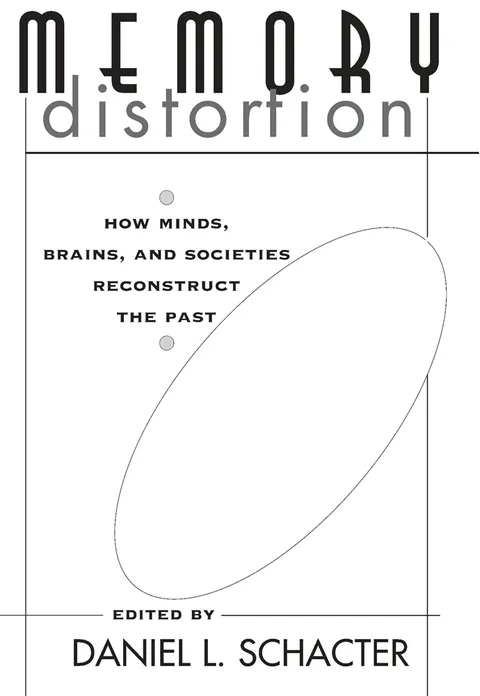
Memory Distortion
How Minds, Brains, and Societies Reconstruct the Past
Report an issue
Tell us what's wrong and we'll take a look.
Thanks – we got it. We'll review and follow up if needed.
Hypnosis, confabulation, source amnesia, flashbulb memories, repression--these and numerous additional topics are explored in this timely collection of essays by eminent scholars in a range of disciplines. This is the first book on memory distortion to unite contributions from cognitive psychology, psychopathology, psychiatry, neurobiology, sociology, history, and religious studies. It brings the most relevant group of perspectives to bear on some key contemporary issues, including the value of eyewitness testimony and the accuracy of recovered memories of sexual abuse.
The distinguished contributors to this volume explore the full range of biological phenomena and social ideas relevant to understanding memory distortion, including the reliability of children's recollections, the effects of hypnosis on memory, and confabulation in brain-injured patients. They also look into the activity and role of brain systems, cellular bases of memory distortion, and the effects of emotion and trauma on the accuracy of memory. In a section devoted to the social aspects of memory distortion, additional essays analyze the media's part in distorting social memory, factors influencing historical reconstruction of the collective past, and memory distortion in religion and other cultural constructs. Daniel Schacter launches the collection with a history of psychological memory distortions. Subsequent highlights include new empirical findings on memory retrieval by a pioneer in the field, some of the foremost research on computational models, studies of the relationship between emotion and memory, new findings on amnesia by a premier neuroscientist, and reflections on the power of collective amnesia in U.S. history, the Nazi Holocaust, and ancient Egypt.
Daniel L. Schacter
DANIEL L. SCHACTER is the William R. Kenan Jr. Professor of Psychology at Harvard University. He has been elected to the National Academy of Sciences and received numerous awards for his research, including the Award for Distinguished Scientific Contributions to Psychology from the American Psychological Association and the Fred Kavli Distinguished Career Contributions Award from the Cognitive Neuroscience Society. He is the author of many books on memory and neuropsychology, including The Seven Sins of Memory and Searching for Memory. Schacter lives in Newton, Massachusetts. ,









Why Readwise Books?
Readwise Books is an ebook & audiobook platform that automatically logs how much you and your friends read, making it fun and easy to read more. Learn more →