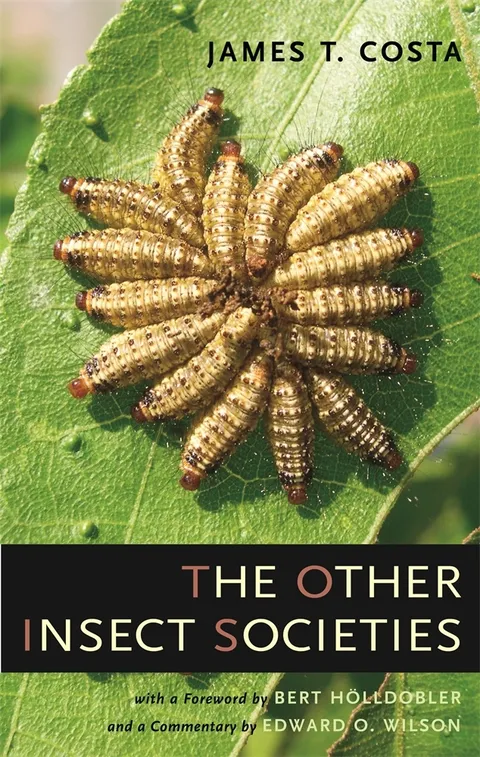
The Other Insect Societies
Report an issue
Tell us what's wrong and we'll take a look.
Thanks – we got it. We'll review and follow up if needed.
Asked to name an insect society, most of us--whether casual or professional students of nature--quickly point to one of the so-called eusocial marvels: the ant colony, the beehive, the termite mound, the wasp nest. Each is awe-inspiring in its division of labor--collective defense, foraging, and nestbuilding. Yet E. O. Wilson cautioned back in 1971 that sociality should be defined more broadly, "in order to prevent the arbitrary exclusion of many interesting phenomena." Thirty-five years later, James T. Costa gives those interesting phenomena their due. He argues that, in trying to solve the puzzle of how highly eusocial behaviors evolved in a few insect orders, evolutionary biologists have neglected the more diverse social arrangements in the remaining twenty-eight orders--insect societies that don't fit the eusocial schema. Costa synthesizes here for the first time the scattered literature about social phenomena across the arthropod phylum: beetles and bugs, caterpillars and cockroaches, mantids and membracids, sawflies and spiders. This wide-ranging tour takes a rich narrative approach that interweaves theory and data analysis with the behavior and ecology of these remarkable groups. This comprehensive treatment is likely to inspire a new generation of naturalists to take a closer look.
James T Costa
James T. Costa is Executive Director of Highlands Biological Station and Professor of Biology at Western Carolina University.
More by James T Costa


Why Readwise Books?
Readwise Books is an ebook & audiobook platform that automatically logs how much you and your friends read, making it fun and easy to read more. Learn more →