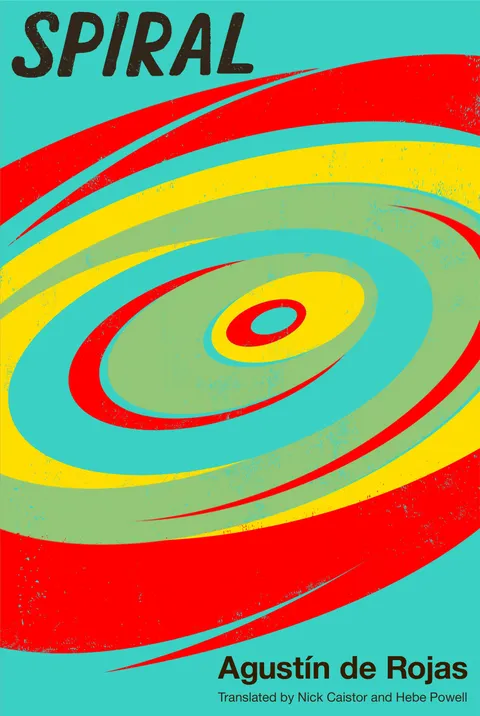
Spiral
Report an issue
Tell us what's wrong and we'll take a look.
Thanks – we got it. We'll review and follow up if needed.
The long-awaited capstone to the landmark trilogy that began with A Legend of the Future and The Year 200 by Agustín de Rojas, “one of Cuba’s greatest science fiction writers” —SF Signal
The winner of Cuba’s prestigious Premio David in 1980, Spiral is another magisterial space opera from the late great science fiction author Agustín de Rojas. Deeply committed to the Revolution, Rojas presents a stunning critique of the Cuban regime under Fidel Castro by inviting the comparison of Spiral’s fictional moral universe, one in which Che Guevara’s principles of socialism are followed to the letter, with the brutal realities of everyday Cuba.
Decades after the devastating Catastrophe, Earth has become a radioactive wasteland sparsely populated by bands of genetically modified humans struggling to survive on limited resources. An expedition of ten explorers from the Aurora planet returns to this desolate landscape to investigate the mysterious causes of its destruction. But when an unexpected guest breaks into their base, the team needs to wield all of its brain power not only to make sense of the helpless planet but also to stay together as a community.
Spiral is a compelling novel concerned with the ethics of scientific exploration and the human relationships caught up in it. Weaving biology, ecology and sociology into this sci-fi narrative, Agustín de Rojas manages to paint a devastating picture of a planet torn apart by two irreconcilable economic powers that so closely resemble the Cold War context in which the story was published.
The novel is very meticulous in its exploration of the professional dilemmas of this crew of scientists and explorers who need to stay true to the utopian values that made the journey possible. Yet it is their emotional responses as human beings that elevate the plot and make Spiral a captivating tale of endurance and curiosity for contemporary readers.
Agustín de Rojas
Agustín de Rojas (1949-2011) is the patron saint of Cuban science fiction. A professor of the history of theater at the Escuela de Instructores de Arte in Villa Clara, he authored a canonical trilogy of novels consisting of Espiral (Spiral, 1982), for which he was awarded the David Prize; Una leyenda del futuro (A Legend of the Future, 1985); and El año 200 (The Year 200, 1990), all of which are scheduled for publication in English translation by Restless Books. While he was heavily influenced by Ray Bradbury and translated Isaac Asimov into Spanish, de Rojas aligned himself mostly with Soviet writers such as Ivan Yefremov and the brothers Arkady and Boris Strugatsky . After the fall of the Soviet Union, de Rojas stopped writing science fiction. He spent his final years persuaded—and persuading others—that Fidel Castro did not exist.
Agustín de Rojas (1949-2011) es el padre de la ciencia ficción cubana. Profesor de historia teatral en la Escuela de Instructores de Arte de Villa Clara, de Rojas es autor de una afamada trilogía que consiste en Espiral (1982), que recibió el Premio David; Una leyenda del futuro (1985); y El año 200 (1990), todas ellas de próxima aparición en traducción al inglés bajo el sello editorial Restless Books. Fuertemente influenciado por Ray Bradbury, de Rojas, que tradujo al español a Isaac Assimov, se sumó a la línea soviética de Ivan Yefremov, los hermanos Arkady y Boris Strugatsky. Luego de la caída de la Unión Soviética, de Rojas dejó de escribir ciencia ficción. Pasó los últimos años de su vida convencido—y convenciendo a los demás—que Fidel Castro no existía.
More by Agustín de Rojas
Hebe Powell
Translated by
Hebe Powell lives and works in London as a freelance translator of Spanish. Born in England, she spent part of her childhood in Argentina and later, a year working and travelling in Spain. She took up a career in physics, completing a PhD in quantum optics at Imperial College London and then as a research scientist in this field. She has also worked as a science teacher. In recent years Hebe has been translating Hispano American fiction. Her first published translation, also a co-translation with Nick Caistor, was Divine Punishment by the renowned Nicaraguan author Sergio Ramírez. Hebe is also a researcher in the field of Spanish pragmatics at Birkbeck College; her work currently focuses on the linguistic strategies employed by users of an online marketplace based in Argentina.


Why Readwise Books?
Readwise Books is an ebook & audiobook platform that automatically logs how much you and your friends read, making it fun and easy to read more. Learn more →