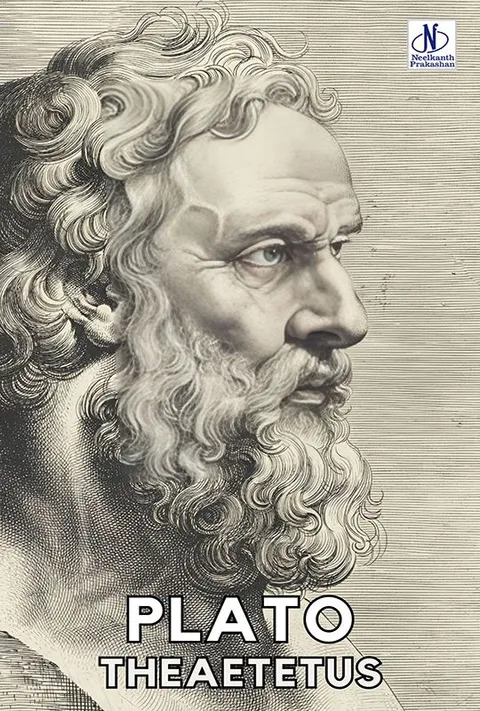
THEAETETUS
Report an issue
Tell us what's wrong and we'll take a look.
Thanks – we got it. We'll review and follow up if needed.
"Theaetetus" is one of Plato's dialogues, written around 369 BCE. In this dialogue, Plato explores the nature of knowledge and perception through a conversation between Socrates and Theaetetus, a young mathematician.
The dialogue begins with Socrates encountering Theaetetus and expressing his curiosity about what Theaetetus is currently studying. Theaetetus reveals that he is engaged in the study of geometry and mathematics, prompting Socrates to ask him what knowledge is. Theaetetus offers several definitions, but each is ultimately challenged by Socrates, leading to a deeper examination of the nature of knowledge.
Throughout the dialogue, Socrates and Theaetetus engage in a dialectical inquiry, considering various theories and definitions of knowledge put forward by prominent thinkers of their time. They discuss concepts such as perception, opinion, true belief, and justification, probing the limits of human understanding and the reliability of sense perception.
One of the central themes of "Theaetetus" is the idea that knowledge is more than just true belief; it also requires justification or rational explanation. Plato suggests that true knowledge involves grasping the essence or form of things, rather than merely perceiving their appearances.
"Theaetetus" is celebrated for its rigorous philosophical inquiry and its exploration of epistemology, the branch of philosophy concerned with the nature and scope of knowledge. It remains a key text in the history of Western philosophy and continues to be studied and debated by scholars and students alike.
Plato
Plato (approx. 424-327 BC) was an ancient Greek philosopher who is commonly regarded as the centermost figure of Western philosophy. During the Classical period of Ancient Greece, he was based in Athens where he founded his own academy and created the Platonist school of thought. Plato's writings touched on a wide range of subjects, including science, human nature, love, sexuality, and metaphysics. He was particularly interested in reconciling the seemingly irreconcilable, writing at length about the dual natures of perception and reality, nature and custom, and body and soul. His works and ideals are among the most influential in Western history, commanding interest, and challenging readers of every era to question their reality and live as paragons of justice and virtue.
More by Plato



Why Readwise Books?
Readwise Books is an ebook & audiobook platform that automatically logs how much you and your friends read, making it fun and easy to read more. Learn more →