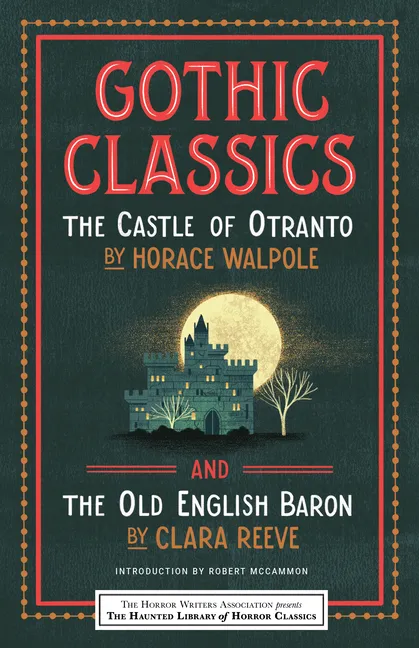
Gothic Classics: The Castle of Otranto and the Old English Baron
Report an issue
Tell us what's wrong and we'll take a look.
Thanks – we got it. We'll review and follow up if needed.
Manfred, the lord of the castle of Otranto, has long lived in dread of an ancient prophecy: it's foretold that when his family line ends, the true owner of the castle will appear and claim it. In a desperate bid to keep the castle, Manfred plans to coerce a young woman named Isabella into marrying him.
Isabella refuses to yield to Manfred's reprehensible plan. But once she escapes into the depths of the castle, it becomes clear that Manfred isn't the only threat. As Isabelle loses herself in the seemingly endless hallways below, voices reverberate from the walls and specters wander through the dungeons. Otranto appears to be alive, and it's seeking revenge for the sins of the past.
Horace Walpole
Horace Walpole (1717-1797) was an English writer, collector, and correspondent. He was the youngest son of Sir Robert Walpole, the politician commonly regarded as Britain's first prime minister. He attended Eton and Cambridge and traveled on the Continent with the poet Thomas Gray. He served in Parliament for part of his adult life, but his most distinctive undertakings were literary and artistic. His extensive correspondence records the people, fashions, and political events of the society in which he lived.Walpole developed his house at Strawberry Hill, in Twickenham, into a conspicuously Gothic building. He collected pictures, objects, and books, and used a private press at the house to print work by himself and others. His interest in the past was selective and inventive. Medieval forms gave him materials for designing rooms and for making books, and he could make their effect depend on how abruptly they entered the life of an eighteenth-century reader.The Castle of Otranto was issued in December 1764 with a title page dated 1765. It initially purported to be an English translation of an old Italian book. In a later preface, Walpole acknowledged his authorship and described his interest in bringing together two kinds of romance, the old and the modern. The story puts ordinary human schemes about marriage and inheritance in a building where supernatural events can abruptly change what anyone is in a position to do. That combination gave later Gothic writers a set of possibilities they could develop in very different directions.Walpole's other works include Anecdotes of Painting in England and The Mysterious Mother, a tragedy. His letters have a separate importance for historians of eighteenth-century society and art. He became the fourth Earl of Orford late in life. The house at Strawberry Hill and the surviving record of his collections make it possible to see how many forms his interest in historical objects took. The Castle of Otranto remains the shortest route into his use of the Gothic imagination. In the novel, a building, a piece of armor, or an image from the past can alter the course of a scene because the people who encounter it have so much invested in believing they know what it means.
More by Horace Walpole



Clara Reeve
Clara Reeve (1729-1807) was an English novelist best known for her contribution to the Gothic literary tradition, particularly through her novel ""The Old English Baron."" She was born in Ipswich, Suffolk, and was the daughter of Reverend William Reeve, a clergyman who likely influenced her interest in literature and history. Reeve's ""The Old English Baron"" is significant for its attempt to blend the supernatural with the believable, setting a precedent for later Gothic fiction. She sought to ground the Gothic elements within a more realistic framework, focusing on historical accuracy and the moral development of characters. Reeve's literary career began relatively late in her life. Her first work, ""The Phoenix"" (1772), was a translation of a Latin work by Bishop Barclay. Clara Reeve is remembered as a pivotal figure in the development of Gothic fiction. Her efforts to make the genre more accessible and morally instructive influenced later writers and helped establish Gothic fiction as a serious literary form. Her blend of romance, history, and Gothic elements set the stage for subsequent developments in the genre, influencing authors such as Ann Radcliffe and Mary Shelley. Reeve's work, particularly ""The Old English Baron,"" remains a touchstone in the study of Gothic literature, marking an important step in the genre's evolution from sensationalism to a more nuanced and morally engaged form of storytelling.
More by Clara Reeve















Why Readwise Books?
Readwise Books is an ebook & audiobook platform that automatically logs how much you and your friends read, making it fun and easy to read more. Learn more →