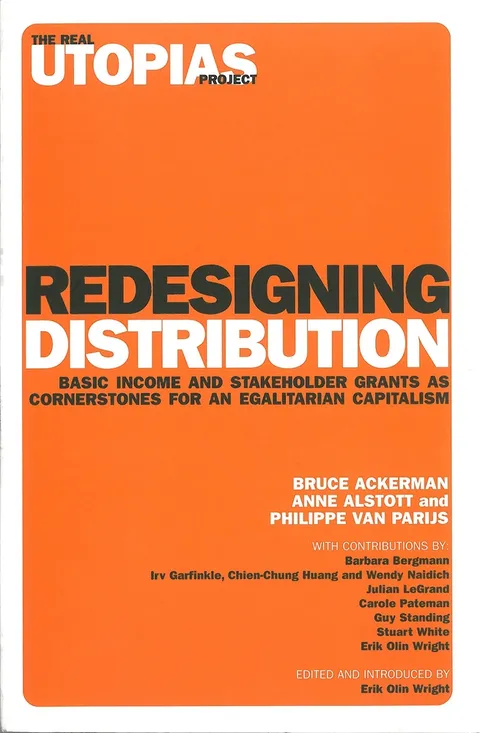
Redesigning Distribution
Basic Income and Stakeholder Grants as Cornerstones for an Egalitarian Capitalism
Report an issue
Tell us what's wrong and we'll take a look.
Thanks – we got it. We'll review and follow up if needed.
Are there ways that contemporary capitalism can be rendered a dramatically more egalitarian economic system without destroying its productivity and capacity for growth?
This book explores two proposals, unconditional basic income and stakeholder grants, that attempt just that. In a system of basic income, as elaborated by Philippe van Parijs, all citizens are given a monthly stipend sufficient to provide them with a no-frills but adequate standard of living. This monthly income is universal rather than means-tested, and it is unconditional -- receiving the basic income does not depend upon performing any labor services or satisfying other conditions. It affirms the idea that as a matter of basic rights, no one should live in poverty in an affluent society. In a system of stakeholder grants, as discussed by Bruce Ackerman and Anne Alstott, all citizens upon reaching the age of early adulthood receive a substantial one-time lump-sum grant sufficiently large so that all young adults would be significant wealth holders. Ackerman and Alstott propose that this grant be in the vicinity of $80,000 and be financed by an annual wealth tax of roughly 2 percent. A system of stakeholder grants, they argue, "expresses a fundamental responsibility: every American has an obligation to contribute to a fair starting point for all."







Philippe Van Parijs
Philippe Van Parijs is Professor of Economic and Social Ethics at the Catholic University of Louvain in Belgium. His books include Evolutionary Explanation in she Social Sciences (1981) and Marxism Recycled (1993).
More by Philippe Van Parijs












Why Readwise Books?
Readwise Books is an ebook & audiobook platform that automatically logs how much you and your friends read, making it fun and easy to read more. Learn more →