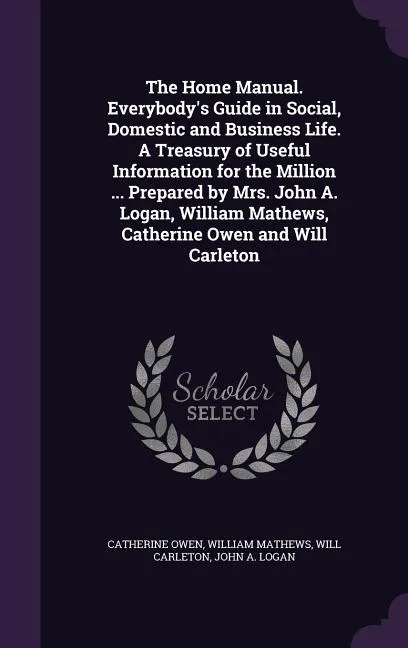
The Home Manual. Everybody's Guide in Social, Domestic and Business Life. A Treasury of Useful Information for the Million ... Prepared by Mrs. John A. Logan, William Mathews, Catherine Owen and Will Carleton
Report an issue
Tell us what's wrong and we'll take a look.
Thanks – we got it. We'll review and follow up if needed.
This work has been selected by scholars as being culturally important, and is part of the knowledge base of civilization as we know it. This work was reproduced from the original artifact, and remains as true to the original work as possible. Therefore, you will see the original copyright references, library stamps (as most of these works have been housed in our most important libraries around the world), and other notations in the work.
This work is in the public domain in the United States of America, and possibly other nations. Within the United States, you may freely copy and distribute this work, as no entity (individual or corporate) has a copyright on the body of the work.
As a reproduction of a historical artifact, this work may contain missing or blurred pages, poor pictures, errant marks, etc. Scholars believe, and we concur, that this work is important enough to be preserved, reproduced, and made generally available to the public. We appreciate your support of the preservation process, and thank you for being an important part of keeping this knowledge alive and relevant.
Catherine Owen
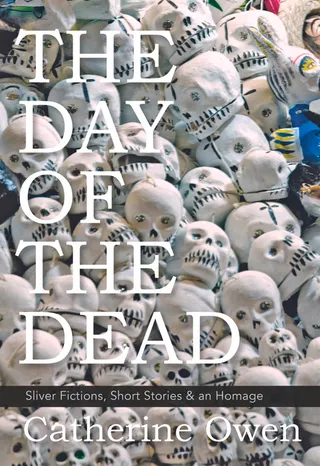
Catherine Owen, from Vancouver, now resides in Edmonton. She is the author of seventeen collections of poetry and prose. Her most recent book of poems, Moving to Delilah, was nominated for both the Al and Eurithe Purdy Poetry Prize and the Robert Kroetsch City of Edmonton Book Prize. She teaches Poetic Forms at Concordia, and edits, reviews and runs the Impromptu Series.
More by Catherine Owen

William Carleton
William Carleton was an Irish author and novelist. He is best known for his book Traits and Stories of the Irish Peasantry, which features ethnic drawings of the traditional Irishman. Carleton's father was a Roman Catholic tenant farmer who supported fourteen children on the same acreage, and Carleton grew up in surroundings similar to those he subsequently depicted in his works. Carleton was immersed in folklore from a young age. His father, who had an amazing memory (he knew the Bible by heart) and, as a native Irish speaker, was well-versed in Irish folklore, told stories by the fireside. Reading the picaresque novel Gil Blas influenced his fluctuating notions about a way of existence. He resolved to see what Fortune had in store for him. He traveled to Killanny, County Louth. For six months, he tutored the family of a farmer named Piers Murphy. After some further tests, he left for Dublin, arriving with two shillings and sixpence in his pocket.
More by William Carleton




Why Readwise Books?
Readwise Books is an ebook & audiobook platform that automatically logs how much you and your friends read, making it fun and easy to read more. Learn more →