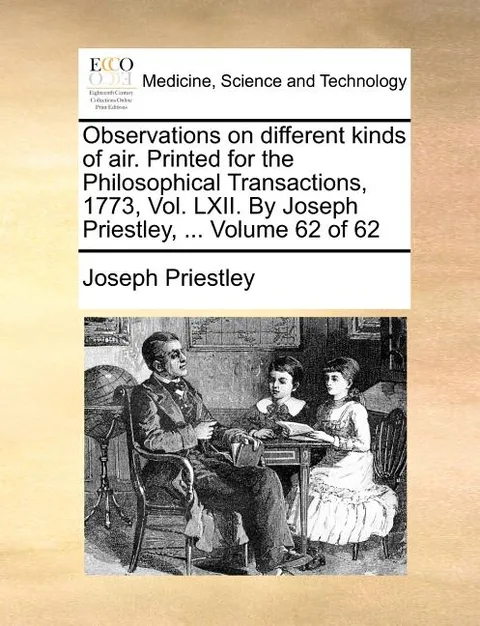
Observations on Different Kinds of Air. Printed for the Philosophical Transactions, 1773, Vol. LXII. by Joseph Priestley, ... Volume 62 of 62
Report an issue
Tell us what's wrong and we'll take a look.
Thanks – we got it. We'll review and follow up if needed.
The 18th century was a wealth of knowledge, exploration and rapidly growing technology and expanding record-keeping made possible by advances in the printing press. In its determination to preserve the century of revolution, Gale initiated a revolution of its own: digitization of epic proportions to preserve these invaluable works in the largest archive of its kind. Now for the first time these high-quality digital copies of original 18th century manuscripts are available in print, making them highly accessible to libraries, undergraduate students, and independent scholars.Medical theory and practice of the 1700s developed rapidly, as is evidenced by the extensive collection, which includes descriptions of diseases, their conditions, and treatments. Books on science and technology, agriculture, military technology, natural philosophy, even cookbooks, are all contained here.++++The below data was compiled from various identification fields in the bibliographic record of this title. This data is provided as an additional tool in helping to insure edition identification: ++++<sourceLibrary>Bodleian Library (Oxford)<ESTCID>T176633<Notes>Later appeared, with alterations and omissions as Part I, Vol. I of his 'Experiments and observations on different kinds of air', London 1774-77.<imprintFull>London: printed by W. Bowyer and J. Nichols, 1772. <collation>120p., plate; 4
Joseph Priestley
English scientist, theologian, and political theorist Joseph Priestley (1733 1804) made numerous contributions to chemistry, physics, and philosophy. Priestley, who was raised in Birstall, West Yorkshire, attended local schools before going to Daventry Academy, where he became very interested in natural philosophy. Priestley made significant scientific advances. His greatest-known discovery, made in 1774, was oxygen, which he dubbed "dephlogisticated air." His investigations into gases and their characteristics, which are detailed in "Experiments and Observations on Different Kinds of Air," greatly enhanced our knowledge of chemistry. Priestley also studied nitrous oxide and carbon dioxide, among other gases. In addition to his scientific interests, Priestley was a prolific writer on theological and political topics as well as a dissident clergyman. He received criticism for his Unitarian beliefs and his perceived radical religious ideas. Priestley was a liberal and democratic idealist whose political writings shaped the early American history.
More by Joseph Priestley


Why Readwise Books?
Readwise Books is an ebook & audiobook platform that automatically logs how much you and your friends read, making it fun and easy to read more. Learn more →