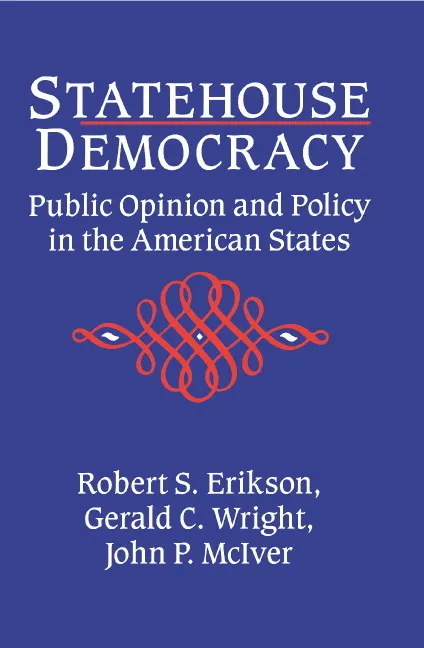
Statehouse Democracy
Report an issue
Tell us what's wrong and we'll take a look.
Thanks – we got it. We'll review and follow up if needed.
The importance of public opinion in the determination of public policy is the subject of considerable debate. Professors Erikson, Wright, and McIver make the argument that state policies are highly responsive to public opinion, and they show how the institutions of state politics work to achieve this high level of responsiveness. They analyze state policies from the 1930s to the present, drawing from and contributing to major lines of research on American politics. Their conclusions are applied to central questions of democratic theory, and affirm the robust character of state institutions.
Gerald C. Wright
Gerald C. Wright taught political science at Indiana University from 1981 until his recent retirement. An accomplished scholar of American politics, and the 2010 winner of the State Politics and Policy Association’s Career Achievement Award, his work includes Statehouse Democracy: Public Opinion and Policy in the American States (1993), coauthored with Robert S. Erikson and John P. McIver, and more than fifty articles on elections, public opinion, and state politics. Professor Wright’s research interests focus on representation – the fundamental relationship among citizens, their preferences, and public policy. He writes primarily about state politics, representation, political parties, and inequality.
He is currently working on a book about parties and representation in U.S. legislatures. He has been a consultant for Project Vote Smart for a number of years and was a founding member of Indiana University’s Freshman Learning Project. In retirement, Professor Wright grows vegetables, golfs, fishes, travels, and plays with his dogs and cat. He is an awesome cook.
More by Gerald C. Wright


Why Readwise Books?
Readwise Books is an ebook & audiobook platform that automatically logs how much you and your friends read, making it fun and easy to read more. Learn more →