Critias - A Platonic Dialogue on Atlantis, Ancient Athens, and Political Virtue
Report an issue
Tell us what's wrong and we'll take a look.
Thanks – we got it. We'll review and follow up if needed.
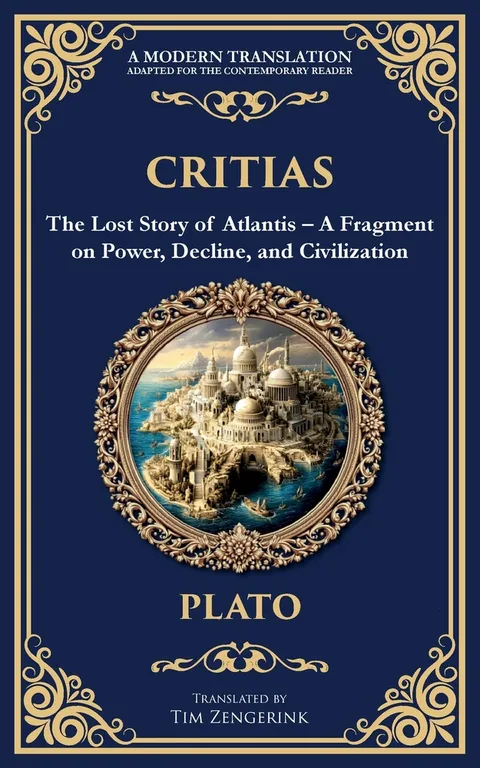
Critias is Plato's unfinished dialogue on ancient Athens, political virtue, and the legendary island power of Atlantis. Presented as a continuation of the conversation begun in Timaeus, the dialogue has Critias recount a story said to have been preserved from Solon: a vast conflict between an idealised ancient Athens and the wealthy, imperial sea-power of Atlantis. Though brief and incomplete, Critias remains one of the most influential classical sources for the Atlantis tradition and a revealing work in Plato's larger examination of politics, order, civic virtue, memory, and decline.
The dialogue should not be treated merely as a curiosity about a lost island. Its importance lies in the way Plato uses mythic history to test political ideals, contrasting disciplined civic excellence with luxury, expansion, and moral corruption. For readers of ancient philosophy, classical literature, Greek political thought, utopian writing, and the long literary afterlife of Atlantis, Critias offers a compact but essential text: fragmentary in form, yet enduring in influence.
Plato
During the Classical era of ancient Greece, the philosopher Plato was born in Athens. He established the Academy, the first university on the European continent, as well as the Platonist school of philosophy. His interpretation of Plotinus had a significant impact on both Islam and Christianity. His theory of Forms, sometimes known as Platonism, is his most well-known contribution. He is also the inspiration for the Platonic solids and Platonic love. Plato was one of the most important figures in the ancient world, and his body of work is said to have persisted unaltered for more than 2,400 years. Even though little of his predecessors' writings have survived, it is believed that he had a significant impact on the works of Socrates, Heraclitus, Pythagoras, and Parmenides. On a tract of land in the Grove of Hecademus or Academus, a mythical Attic figure, Plato built it. The Academy remained in operation until Lucius Cornelius Sulla demolished it in 84 BC. Seneca claims that Plato passed away on the day of his birth at the age of 81. The Suda reports that he lived to be 82 years old, but Neanthes states that he was 84 years old. Tertullian said that Plato merely passed away while sleeping. By will, Plato bequeathed his Iphistiadae land to a younger relative.
More by Plato





Why Readwise Books?
Readwise Books is an ebook & audiobook platform that automatically logs how much you and your friends read, making it fun and easy to read more. Learn more →