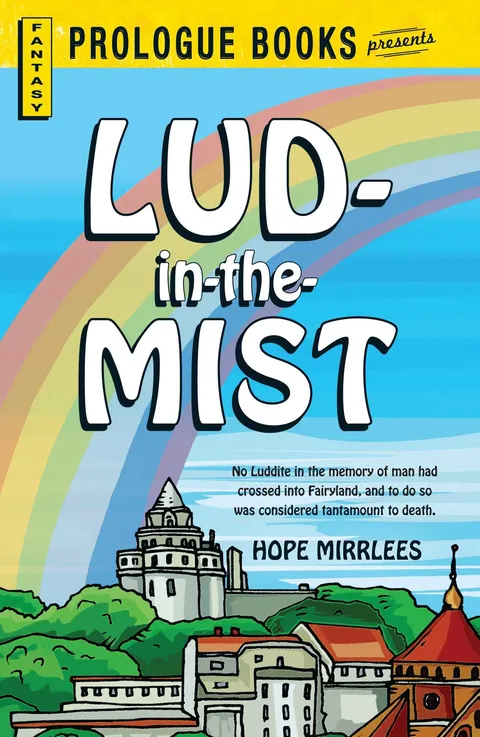
Lud-in-the-Mist
Report an issue
Tell us what's wrong and we'll take a look.
Thanks – we got it. We'll review and follow up if needed.
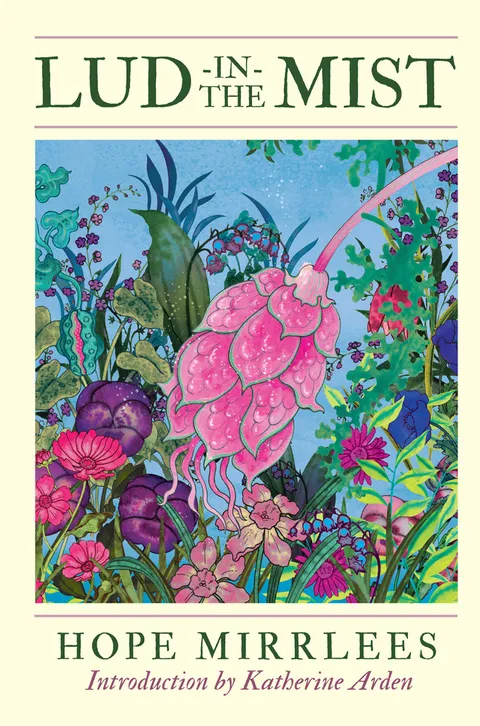
The book that New York Times bestselling author Neil Gaiman considers "one of the finest [fantasy novels] in the English language."
Between the mountains and the sea, between the sea and Fairyland, lay the Free State of Dorimare and its picturesque capital, Lud-in-the-Mist. No Luddite ever had any truck with fairies or Fairyland. Bad business, those fairies. The people of Dorimare had run them out generations ago--and the Duke of Dorimare along with them.
Until the spring of his fiftieth year, Master Nathaniel Chanticleer, Mayor of Lud-in-the-Mist and High Seneschal of Dorimare, had lived a sleepy life with his only son, Ranulph. But as he grew, Ranulph was more and more fond of talking nonsense about golden cups, and snow-white ladies milking azure cows, and the sound of tinkling bridles at midnight. And when Ranulph was twelve, he got caught up with the fairies, and Nathaniel's life would never be the same.
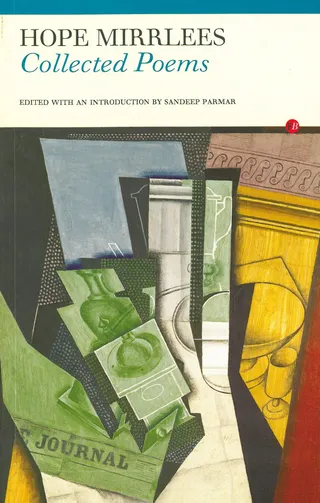
Hope Mirrlees
Helen Hope Mirrlees was born on 8 April 1887 at Chislehurst, Kent, the eldest surviving child of a Glasgow sugar-machinery industrialist, and grew up between Scotland and Natal, where she learned Zulu from her nurse. Educated at St Leonard's School, St Andrews, she was presented at court in 1907, tried the stage briefly at the Royal Academy of Dramatic Art, and gave it up for classics. In 1910 she went up to Newnham College, Cambridge, to read under the scholar of Greek religion Jane Ellen Harrison. She left in 1913 without a degree and with Harrison, thirty-seven years her senior, who became her companion for the next fifteen years.The two lived between Bloomsbury and the Left Bank, studying Russian and translating together. Mirrlees's first novel, Madeleine, set in the Paris salon of Madame de Scudéry, was placed with Collins in 1919 with Virginia Woolf's help. Paris: A Poem followed in 1920 from the Hogarth Press, 175 copies set by hand by Woolf herself; Julia Briggs, her Oxford Dictionary of National Biography biographer, later called it "modernism's lost masterpiece." The Counterplot, her one novel set in the present, and a translation of the autobiography of the Archpriest Avvakum, made with Harrison, came in 1924. Lud-in-the-Mist, published by Collins in 1926, was her third novel and her last. It was reviewed in The Spectator, The Times Literary Supplement and The New York Times Book Review, then went out of print for forty-four years.Harrison died in April 1928. Mirrlees converted to Roman Catholicism soon afterwards and published no book for thirty-six years. Through much of the Second World War T. S. Eliot lodged in the Surrey house she shared with her mother, and wrote The Dry Salvages and Little Gidding there. Her biography of the antiquary Sir Robert Cotton, A Fly in Amber, appeared from Faber and Faber in 1962; its second volume remains unpublished. She allowed Paris back into print in 1973, cut by her own hand, and gathered a last collection of poems, Moods and Tensions, in 1976. She died at Goring on 1 August 1978, aged ninety-one.
More by Hope Mirrlees




Why Readwise Books?
Readwise Books is an ebook & audiobook platform that automatically logs how much you and your friends read, making it fun and easy to read more. Learn more →