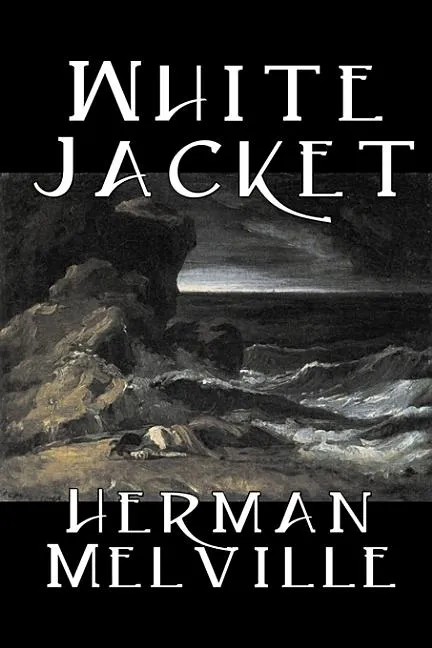
White Jacket by Herman Melville, Fiction, Classics, Sea Stories
Report an issue
Tell us what's wrong and we'll take a look.
Thanks – we got it. We'll review and follow up if needed.
The mixture of journalism, history and fiction; the presentation of a sequence of striking characters; the metaphor of a sailing ship as the world in miniature-all of these prefigure his next novel, Moby-Dick. The symbolism of the color white, introduced in this novel in the form of the narrator's jacket, is more fully expanded upon in Moby-Dick, where it becomes an all-encompassing "blankness."
Melville's (best known for his classic whaling novel) The White Jacket written by Herman Melville (best known for his classic whaling novel) was first published in 1850 and is considered to be a semi-biographical book, written from Melville's own personal experiences while returning home to the Atlantic Coast from the South Seas with the American Navy on a man-o-war vessel. In the note preceding the novel, Melville states, "In the year 1843 I shipped as 'ordinary seaman' on board of a United States frigate then lying in a harbor of the Pacific Ocean. After remaining in this frigate for more than a year, I was discharged from the service . . ."
Herman Melville
Herman Melville (1819–1891) was an American novelist, short story writer, essayist, and poet who received wide acclaim for his earliest novels, such as Typee and Redburn, but fell into relative obscurity by the end of his life. Today, Melville is hailed as one of the definitive masters of world literature for novels including Moby Dick and Billy Budd, as well as for enduringly popular short stories such as Bartleby, the Scrivener and The Bell-Tower.
More by Herman Melville


Why Readwise Books?
Readwise Books is an ebook & audiobook platform that automatically logs how much you and your friends read, making it fun and easy to read more. Learn more →