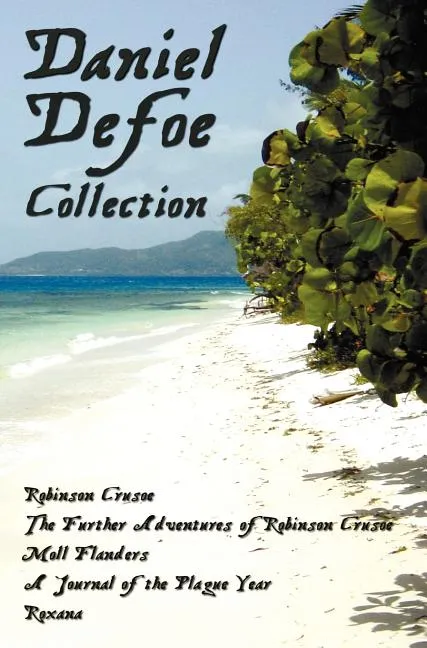
Daniel Defoe Collection (Unabridged)
Robinson Crusoe, the Further Adventures of Robinson Crusoe, Moll Flanders, a Journal of the Plague Year and Roxa
Report an issue
Tell us what's wrong and we'll take a look.
Thanks – we got it. We'll review and follow up if needed.
"Robinson Crusoe" was a castaway as a result of a terrible storm at sea. He was left with only a knife, some tobacco and a pipe. And so starts his education in how to survive, he learns how to build a canoe, make bread, and endure endless solitude. Until twenty-four years later he meets another human being. Robinson Crusoe has been praised by such writers as James Joyce, Virginia Woolf, and Samuel Johnson as one of the greatest novels in the English language. "The Further Adventures of Robinson Crusoe" start in England, where he is married with three children and has bought a farm. But he is desperate to see his island and can think of nothing else. His wife tells his she will go with him but then dies. And so the story unfolds and the travelling begins taking us back to the island, to Madagascar, Southeast Asia and China and then on to Siberia. "Moll Flanders" was also praised by Virginia Woolf, saying it was one of the "few English novels which we can call indisputably great." Defoe wrote this story under a pseudonym, giving the impression that the story was actually an autobiography. The tale is a journey from rags to riches of a woman who was born in prison and ascends to wealth and status. Defoe catalogues her misdemeanours, her spirit, her determination and her varied careers from a prostitute, a charming and faithful wife, a thief, and a convict. The title page gives the synopsis: "The Fortunes & Misfortunes of the Famous Moll Flanders &c. Who was Born in Newgate, and during a Life of continu'd Variety for Threescore Years, besides her Childhood, was Twelve Year a Whore, five times a Wife (whereof once to her own Brother), Twelve Year a Thief, Eight Year a Transported Felon in Virginia, at last grew Rich, liv'd Honest, and dies a Penitent. Written from her own Memorandums . . ." "A Journal of the Plague Year" chronicles the year 1665, when the Great Plague swept through London, claiming nearly 100,000 lives. Defoe so vividly chronicles the progress of the disease that this book has frequently been miscategorised as "non-fiction". Defoe is utterly convincing and this book transports us to the city, through the deserted streets and beside the houses with crosses daubed on their doors, introduces us to the citizens and we feel with them the horror, fear and hysteria growing. "Roxana" is Defoe's last and darkest novel. Again it is an autobiography of a woman who has traded her virtue, at first for survival, and then for fame and fortune. This woman is well aware of the price she is paying and of her weaknesses. She tries to learn the lessons of her trails and struggles in life. But unlike his other characters, she fails conquer these weaknesses.
Daniel Defoe
English author Daniel Defoe was at times a trader, political activist, criminal, spy and writer, and is considered to be one of England’s first journalists. A prolific writer, Defoe is known to have used at least 198 pen names over the course of a career in which he produced more than five hundred written works. Defoe is best-known for his novels detailing the adventures of the castaway Robinson Crusoe, which helped establish and popularize the novel in eighteenth century England. In addition to Robinson Crusoe, Defoe penned other famous works including Captain Singleton, A Journal of the Plague Year, Captain Jack, Moll Flanders and Roxana. Defoe died in 1731.
More by Daniel Defoe




Why Readwise Books?
Readwise Books is an ebook & audiobook platform that automatically logs how much you and your friends read, making it fun and easy to read more. Learn more →