Report an issue
Tell us what's wrong and we'll take a look.
Thanks – we got it. We'll review and follow up if needed.
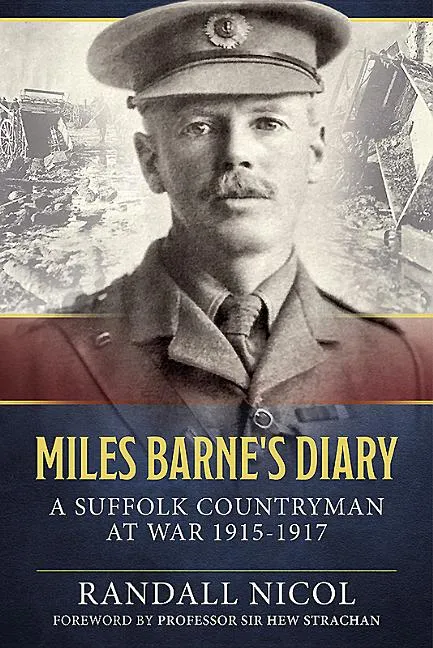
Miles Barne's diary reveals a lifelong observer who, amid war's chaos, records ordinary life, intimate encounters, and humane resilience with clear, unvarnished honesty that highlights enduring human dignity.
Miles Barne, then aged forty one, who lived at Sotterley, Suffolk, rejoined the Scots Guards in June 1915. He began his Diary on 23 July as he left for the Western Front and, apart from when on leave, recorded life with the 1st Battalion Scots Guards almost every day in the most straightforward, but vivid, way. That included everything that he saw and heard within his own immediate sphere. Often it was far from military. So he noted the countryside and crops, farms and villages, flowers and plants, woods and trees, animals and birds. While his accounts of his more terrible experiences such as Loos, some of the trench tours in the Ypres Salient and of the dreadful Somme winter of 1916-17 catch the attention immediately, those of other events elsewhere and away from the fighting are of just as much interest. He died after being mortally wounded on 17 September 1917 by a bomb inadvertently dropped by a British plane, well behind the line near Ypres.
Miles Barne never intended that anyone beyond his close family should read the Diary, which is open, direct, detailed and unvarnished, as well as being very humble, very much reflecting his own personality. It has been lying almost untouched at his home for a hundred years and is supported now by contemporary documents, which he saved because of their personal importance to him.
One of the Diary's most distinctive features is the very large number of people whom he mentioned meeting, including many individual soldiers, as well as officers. Notably, whenever there was a battalion from Norfolk or Suffolk in his neighborhood he was quickly off to see who he knew already and meet others. Quite apart from East Anglia, his range of relations, friends and acquaintances from before the War was wide and then there were all the many others he met. It has been possible to identify a very large proportion of them.'
Randall Nicol
Randall Nicol read history at Magdalene College, Cambridge, and served for ten years afterwards in the Scots Guards. On leaving the Army he read law at Edinburgh University and qualified as a solicitor practising in Scotland. He has written many articles for the Guards Magazine and the Scots Guards Magazine, chairs the Regimental Historical Committee Scots Guards and is a member of the British Commission for Military History. He and his wife live in Edinburgh.//His first book Till The Trumpet Sounds Again: The Scots Guards 1914-1919 in Their Own Words (Solihull: Helion & Co Ltd 2016) won the Best First Book Prize at the Society for Army Historical Research Templer Medal Awards 2016.
More by Randall Nicol


Why Readwise Books?
Readwise Books is an ebook & audiobook platform that automatically logs how much you and your friends read, making it fun and easy to read more. Learn more →