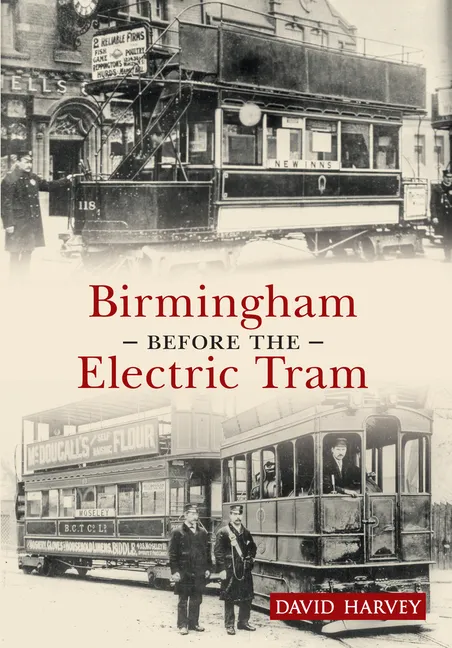
Birmingham Before the Electric Tram
Report an issue
Tell us what's wrong and we'll take a look.
Thanks – we got it. We'll review and follow up if needed.
During the nineteenth century, Birmingham grew rapidly, becoming the second largest population centre in England. Tramways were introduced to the city as a more efficient way of transporting this large population. Although the first trams were horse-drawn, more efficient power sources were developed and in this book, David Harvey shows us three which were employed by the City of Birmingham Tramways Company between 1896 and 31 December 1911, following which the company was absorbed by Birmingham Corporation Tramways. City of Birmingham ran routes using steam trams, cable trams (such as are still used in San Francisco today) and battery-powered accumulator trams until these were swept away by the considerably more efficient electric trams which we remember today, their power supplied through overhead cables. In this wonderful collection of period images, David Harvey shows us Birmingham, Britain's Second City, through its public transport as the nineteenth century turned into the twentieth. This is a vivid look at the architecture and technology of Victorian and Edwardian Britain at its height.
David Harvey
David Harvey teaches at the Graduate Center of the City University of New York and is the author of many books, including Social Justice and the City, The Condition of Postmodernity, The Limits to Capital, A Brief History of Neoliberalism, Spaces of Global Capitalism, and A Companion to Marx's Capital. His website is http://davidharvey.org
More by David Harvey








Why Readwise Books?
Readwise Books is an ebook & audiobook platform that automatically logs how much you and your friends read, making it fun and easy to read more. Learn more →