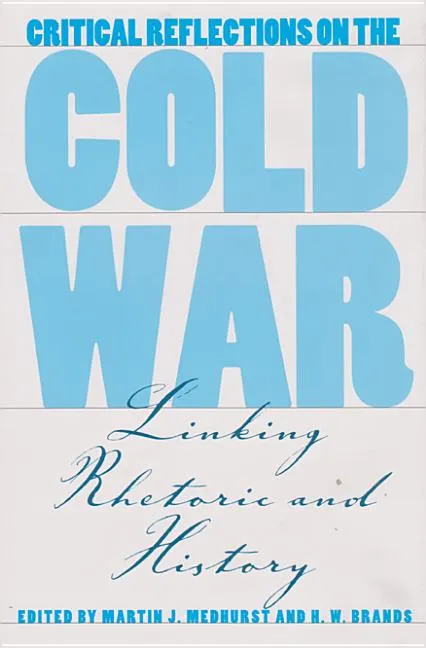
Critical Reflections on the Cold War
Linking Rhetoric and History Volume 2
Report an issue
Tell us what's wrong and we'll take a look.
Thanks – we got it. We'll review and follow up if needed.
The book opens with Norman Graebner's wideranging analysis of the rhetorical background of the Cold War. Frank Costigliola then parses Stalin's speech of February, 1946, an address that many in the West took as a declaration of war by the USSR. The development of NSC68 in 1950, often referred to as America's "blueprint" for fighting the Cold War, is the subject of Robert P. Newman's review.
Shawn J. ParryGiles and J. Michael Hogan then focus on American propaganda responses to the perceived Soviet threat. H. W. Brands, Randall B. Woods, and Rachel L. Holloway examine the effects of liberal ideology and rhetoric on domestic and foreign policy decisions. Robert J. McMahon and Robert L. Ivie raise the issue of what it has meant to be the "leader of the Free World" and what the task of postCold War rhetoric will be in this regard.
Scholars concerned with the role of words in public life and in the study of history will find challenging material in this interdisciplinary volume. Historians, speech communication scholars, and political scientists with an interest in the Cold War will similarly find grist for further milling.
H W Brands
H. W. Brands taught at Vanderbilt University and Texas A&M University before joining the faculty at the University of Texas at Austin, where he is the Dickson Allen Anderson Centennial Professor of History. A writer on American history and politics, his books include Traitor to His Class, Andrew Jackson, The Age of Gold, and The First American. Several of his books have been bestsellers, and two, Traitor to His Class and The First American, were finalists for the Pulitzer Prize. He lectures frequently on historical and current events, and can be seen and heard on national and international television and radio programs.


Why Readwise Books?
Readwise Books is an ebook & audiobook platform that automatically logs how much you and your friends read, making it fun and easy to read more. Learn more →