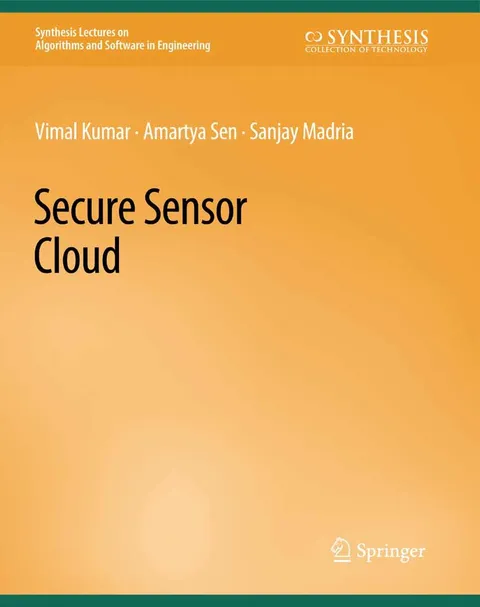
Secure Sensor Cloud
Report an issue
Tell us what's wrong and we'll take a look.
Thanks – we got it. We'll review and follow up if needed.
The sensor cloud is a new model of computing paradigm for Wireless Sensor Networks (WSNs), which facilitates resource sharing and provides a platform to integrate different sensor networks where multiple users can build their own sensing applications at the same time. It enables a multi-user on-demand sensory system, where computing, sensing, and wireless network resources are shared among applications. Therefore, it has inherent challenges for providing security and privacy across the sensor cloud infrastructure. With the integration of WSNs with different ownerships, and users running a variety of applications including their own code, there is a need for a risk assessment mechanism to estimate the likelihood and impact of attacks on the life of the network. The data being generated by the wireless sensors in a sensor cloud need to be protected against adversaries, which may be outsiders as well as insiders. Similarly, the code disseminated to the sensors within the sensor cloud needs to be protected against inside and outside adversaries. Moreover, since the wireless sensors cannot support complex and energy-intensive measures, the lightweight schemes for integrity, security, and privacy of the data have to be redesigned.
The book starts with the motivation and architecture discussion of a sensor cloud. Due to the integration of multiple WSNs running user-owned applications and code, the possibility of attacks is more likely. Thus, next, we discuss a risk assessment mechanism to estimate the likelihood and impact of attacks on these WSNs in a sensor cloud using a framework that allows the security administrator to better understand the threats present and take necessary actions. Then, we discuss integrity and privacy preserving data aggregation in a sensor cloud as it becomes harder to protect data in this environment. Integrity of data can be compromised as it becomes easier for an attacker to inject false data in a sensor cloud, and due to hop by hopnature, privacy of data could be leaked as well. Next, the book discusses a fine-grained access control scheme which works on the secure aggregated data in a sensor cloud. This scheme uses Attribute Based Encryption (ABE) to achieve the objective. Furthermore, to securely and efficiently disseminate application code in sensor cloud, we present a secure code dissemination algorithm which first reduces the amount of code to be transmitted from the base station to the sensor nodes. It then uses Symmetric Proxy Re-encryption along with Bloom filters and Hash-based Message Authentication Code (HMACs) to protect the code against eavesdropping and false code injection attacks.


Amartya Sen
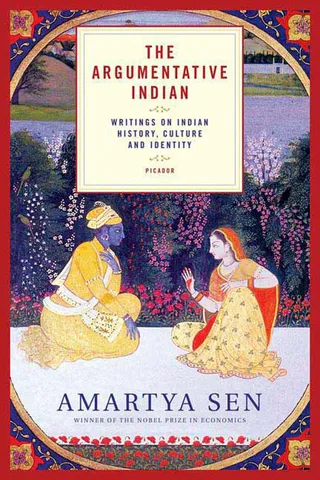
Amartya Sen is a professor of economics and philosophy at Harvard University. A former Master of Trinity College, Cambridge, he won the Nobel Prize for Economic Sciences in 1998 and the National Humanities Medal in 2011. His many celebrated books include Development as Freedom and The Idea of Justice.
More by Amartya Sen





Why Readwise Books?
Readwise Books is an ebook & audiobook platform that automatically logs how much you and your friends read, making it fun and easy to read more. Learn more →