Report an issue
Tell us what's wrong and we'll take a look.
Thanks – we got it. We'll review and follow up if needed.
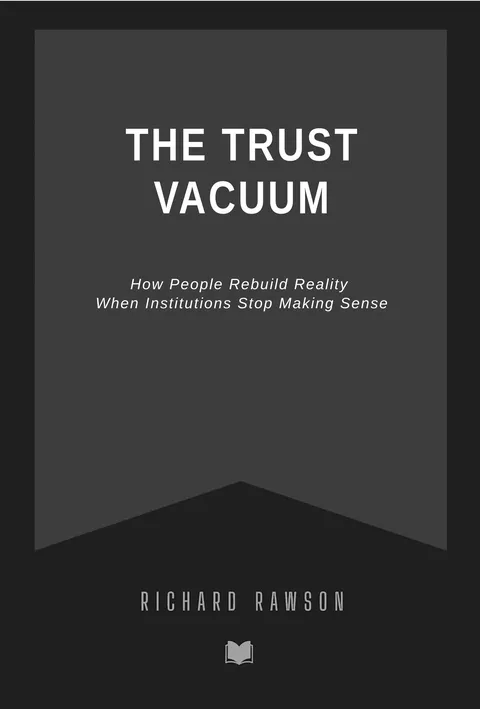
Why does it feel like people no longer agree on what's real? Institutions still exist. Experts still speak. News still flows. But for many people, something more basic has changed. Authority no longer organizes reality in the way it once did. Trust has thinned. Shared standards have weakened. And in the space left behind, people are building their own systems for deciding what is true.
The Trust Vacuum is not a book about misinformation, ignorance, or cognitive bias. It is about what happens psychologically and socially when shared authority stops working. It examines how people respond when familiar sources of credibility no longer feel reliable, and why skepticism is rarely the end point. Instead, people construct replacement systems-personal rules, group narratives, identity-based trust, influencers, and alternative authorities-to make the world feel coherent and livable again.
Drawing on psychology, social dynamics, and everyday experience, this book explores:
● Why people need usable, coherent reality to function
● How private rules for truth quietly replace shared standards
● Why identity and belonging now shape credibility
● How subcultures become trust infrastructure
● Why influencers and para-experts gain authority
● How "do your own research" becomes a moral identity
● Why narrative often outweighs institutional evidence
● How conspiracy systems provide structure and meaning
● Why beliefs persist even after disconfirmation
● How competing realities strain relationships and social life
Rather than treating people as irrational or broken, The Trust Vacuum shows how many modern belief patterns are adaptive responses to a fragmented trust environment. It explains not just what people believe, but what those beliefs are doing for them-emotionally, socially, and psychologically.
This is a book for anyone trying to understand why conversations feel harder, why disagreement feels deeper, and why reality itself now seems contested. It does not offer easy fixes. It offers clarity about the condition we are living in, and what it means to live in a world where shared reality is no longer guaranteed.
Richard A Rawson
Richard A. Rawson, PhD, is professor in residence in the department of psychiatry at the University of California, Los Angeles (UCLA), and codirector of the UCLA Integrated Substance Abuse Programs. He has worked in the substance abuse field since 1974. Rawson started the Matrix Institute on Addictions and conducts training on topics including basic principles of addiction and addiction treatment for counselors, MFCCs, psychologists, and physicians, and much more.
More by Richard A Rawson



Why Readwise Books?
Readwise Books is an ebook & audiobook platform that automatically logs how much you and your friends read, making it fun and easy to read more. Learn more →