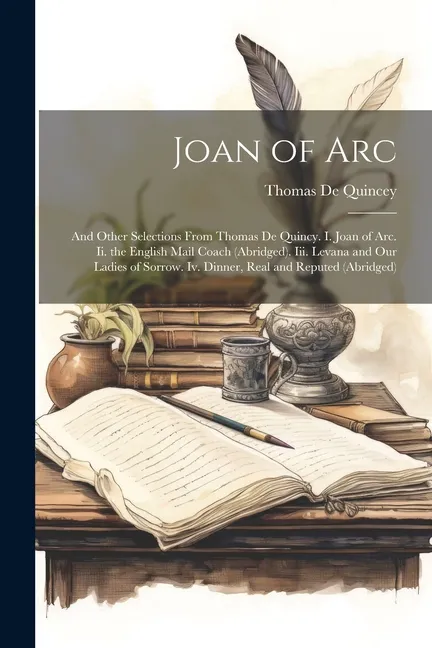
Joan of Arc
And Other Selections From Thomas De Quincy. I. Joan of Arc. Ii. the English Mail Coach (Abridged). Iii. Levana and Our Ladies of Sorrow. Iv. Dinner, Real and Reputed (Abridged)
Report an issue
Tell us what's wrong and we'll take a look.
Thanks – we got it. We'll review and follow up if needed.
This compilation includes four of Thomas De Quincey's essays. Joan of Arc, The English Mail Coach, Levana and Our Ladies of Sorrow, and Dinner, Real and Reputed (abridged). De Quincey's contemplative style and detailed descriptions make him an excellent essayist and storyteller, making these essays a must-read for literary enthusiasts.
This work has been selected by scholars as being culturally important, and is part of the knowledge base of civilization as we know it.
This work is in the "public domain in the United States of America, and possibly other nations. Within the United States, you may freely copy and distribute this work, as no entity (individual or corporate) has a copyright on the body of the work.
Scholars believe, and we concur, that this work is important enough to be preserved, reproduced, and made generally available to the public. We appreciate your support of the preservation process, and thank you for being an important part of keeping this knowledge alive and relevant.
Thomas de Quincey
Thomas De Quincey (1785-1859) was an English essayist, autobiographer, and critic whose work links Romantic literary culture with the nineteenth-century magazine press. Born in Manchester into a merchant family, he received a classical education and showed an early aptitude for languages. At seventeen he left Manchester Grammar School and traveled in Wales before spending a difficult period in London. These youthful experiences became material for the autobiographical writing through which many readers first encountered him.De Quincey attended Worcester College, Oxford, but did not complete a degree. His admiration for William Wordsworth drew him toward the Lake District, where he came to know Wordsworth, Samuel Taylor Coleridge, and members of their circle. He lived for a time at Dove Cottage in Grasmere. He married Margaret Simpson and supported a growing family through journalism, including work on the Westmorland Gazette. Financial pressure remained an important circumstance of his professional life.Confessions of an English Opium-Eater appeared in the London Magazine in 1821. It made his experience of opium the basis of an unusual literary self-portrait, combining recollection with analysis and disturbing dream imagery. De Quincey returned to the work in a much enlarged version published in 1856. The two versions are distinct texts, and their differences reflect his continuing reconstruction of his own past rather than a simple correction of a settled account.He eventually made Edinburgh his home and wrote on a remarkable range of subjects for periodicals. His essays include literary reminiscences, criticism, history, philosophy, and satirical treatments of crime. Suspiria de Profundis and The English Mail-Coach extend his exploration of memory and visionary experience, while On Murder Considered as One of the Fine Arts displays his capacity for disquieting comedy. He died in Edinburgh in 1859. His career is best understood through this range, in which learned exposition and imaginative prose continually meet, rather than through the subject of opium alone.The Confessions established De Quincey's public identity as the English Opium-Eater, but it is also a carefully constructed work of prose. First published in 1821 and extensively revised in 1856, it remained a text he continued to reshape. Its relation to his later dream writings makes it an entry into his literary imagination as well as an account of his use of a drug.
More by Thomas de Quincey




Why Readwise Books?
Readwise Books is an ebook & audiobook platform that automatically logs how much you and your friends read, making it fun and easy to read more. Learn more →