Report an issue
Tell us what's wrong and we'll take a look.
Thanks – we got it. We'll review and follow up if needed.
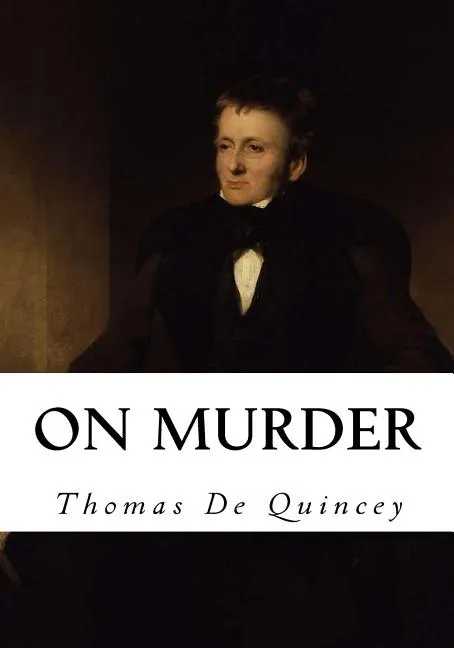
"On Murder Considered as one of the Fine Arts" is an essay by Thomas De Quincey first published in 1827 in Blackwood's Magazine. The essay is a fictional, satirical account of an address made to a gentleman's club concerning the aesthetic appreciation of murder. It focuses particularly on a series of murders allegedly committed in 1811 by John Williams in the neighborhood of Ratcliffe Highway, London. The essay was enthusiastically received and led to numerous sequels, including "A Second Paper on Murder Considered as one of the Fine Arts" in 1839 and a "Postscript" in 1854. These essays have exerted a strong influence on subsequent literary representations of crime and were lauded by such critics as G. K. Chesterton, Wyndham Lewis and George Orwell. De Quincey also refers to the Williams murders in his "On the Knocking at the Gate in Macbeth."
Thomas de Quincey
Thomas De Quincey (1785-1859) was an English essayist, autobiographer, and critic whose work links Romantic literary culture with the nineteenth-century magazine press. Born in Manchester into a merchant family, he received a classical education and showed an early aptitude for languages. At seventeen he left Manchester Grammar School and traveled in Wales before spending a difficult period in London. These youthful experiences became material for the autobiographical writing through which many readers first encountered him.De Quincey attended Worcester College, Oxford, but did not complete a degree. His admiration for William Wordsworth drew him toward the Lake District, where he came to know Wordsworth, Samuel Taylor Coleridge, and members of their circle. He lived for a time at Dove Cottage in Grasmere. He married Margaret Simpson and supported a growing family through journalism, including work on the Westmorland Gazette. Financial pressure remained an important circumstance of his professional life.Confessions of an English Opium-Eater appeared in the London Magazine in 1821. It made his experience of opium the basis of an unusual literary self-portrait, combining recollection with analysis and disturbing dream imagery. De Quincey returned to the work in a much enlarged version published in 1856. The two versions are distinct texts, and their differences reflect his continuing reconstruction of his own past rather than a simple correction of a settled account.He eventually made Edinburgh his home and wrote on a remarkable range of subjects for periodicals. His essays include literary reminiscences, criticism, history, philosophy, and satirical treatments of crime. Suspiria de Profundis and The English Mail-Coach extend his exploration of memory and visionary experience, while On Murder Considered as One of the Fine Arts displays his capacity for disquieting comedy. He died in Edinburgh in 1859. His career is best understood through this range, in which learned exposition and imaginative prose continually meet, rather than through the subject of opium alone.The Confessions established De Quincey's public identity as the English Opium-Eater, but it is also a carefully constructed work of prose. First published in 1821 and extensively revised in 1856, it remained a text he continued to reshape. Its relation to his later dream writings makes it an entry into his literary imagination as well as an account of his use of a drug.
More by Thomas de Quincey





Why Readwise Books?
Readwise Books is an ebook & audiobook platform that automatically logs how much you and your friends read, making it fun and easy to read more. Learn more →