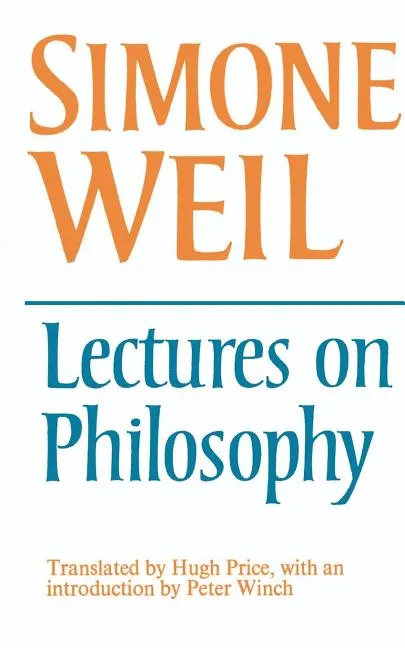
Lectures on Philosophy
Report an issue
Tell us what's wrong and we'll take a look.
Thanks – we got it. We'll review and follow up if needed.
Simone Weil's Leçons de Philosophie are derived from a course she taught at the lycée for girls at Roanne in 1933-4. Anne Reynaud-Guérithault was a pupil in the class; her notes are not a verbatim record but are a very full and, as far as one can judge, faithful rendering, often catching the unmistakable tone of Simone Weil's voice as well as the force and the directness of her thought. The lectures form a good general introduction to philosophy, ranging widely over problems about perception, mind, language, reasoning and problems in moral and political philosophy too. Her method of presentation is a characteristic combination of abstract argument, personal experience and literary or historical reference. Peter Winch points out in his introduction to the book some of the more systematic connections in her philosophical work (and between this philosophical work and her other concerns), and makes a number of suggestive comparisons between Simone Weil and Wittgenstein. The translation is by Hugh Price from the Plon edition of 1959. Dr Price has added some notes to explain references in the text that might be unfamiliar to English speaking students beginning philosophy.
Simone Weil
Born in 1909 to a Jewish family in Paris, Simone Weil had a privileged childhood. An academic prodigy, she left a teaching career to become a factory worker in order to better feel and know the afflictions of the working class. Though drawn to pacifism, she went to Spain to fight the Nationalists in the Spanish Civil War. An agnostic, her hunger for beauty, virtue, and goodness was fed by her conviction that anyone can enter “the kingdom of truth” if only “he longs for truth and perpetually concentrates all his attention on its attainment.” She never conceived of the possibility of a “real contact, person to person, here below, between a human being and God” until one day “Christ himself came down and took possession of me.” Though she would remain religiously unaffiliated her entire life, the reality of this experience never left her. Simone Weil fled France when the Nazis invaded and joined the French resistance in London. In solidarity, she committed to eating the same rations as the men at the front. During the summer of 1943, she contracted tuberculosis and, weakened by malnourishment, she died within weeks.
More by Simone Weil








Why Readwise Books?
Readwise Books is an ebook & audiobook platform that automatically logs how much you and your friends read, making it fun and easy to read more. Learn more →