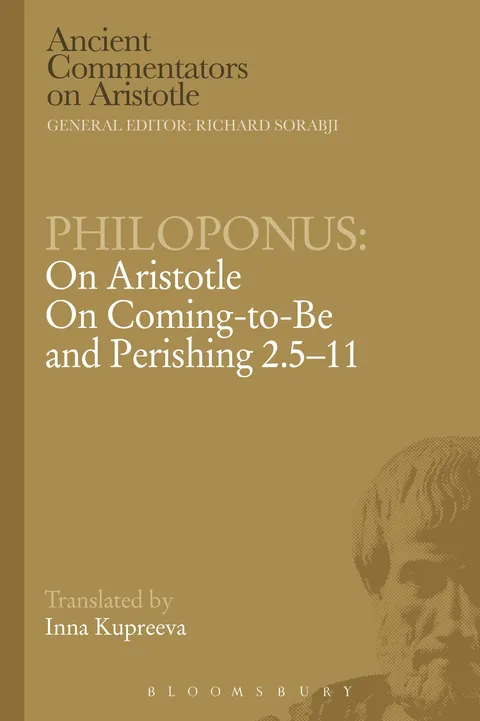
Philoponus: On Aristotle On Coming to be and Perishing 2.5-11
Report an issue
Tell us what's wrong and we'll take a look.
Thanks – we got it. We'll review and follow up if needed.
Until the launch of this series over ten years ago, the 15,000 volumes of the ancient Greek commentators on Aristotle, written mainly between 200 and 600 AD, constituted the largest corpus of extant Greek philosophical writings not translated into English or other European languages. Subjects covered in this, the third and last, volume of translation of this work include: why the elements are four in number; what's wrong with Empedocles' theory of elements; how homogeneous stuffs, particularly the tissues of a living body, come to be and consist of the elements. The volume also contains very important discussions of causes, particularly of efficient cause, and of necessity in the sphere of generation and corruption. It is of interest to students of ancient philosophy and science (the commentary draws on earlier philosophical and medical texts); of Patristics and Christian Theology (it allows comparison of Philoponus' later creationist doctrine with his earlier ideas about generation); of medieval philosophy (this text was known to the Arabs; it is used by Avicenna and Averroes); and to anyone with interest in the metaphysics of causation, emergence, necessity and determinism.
Inna Kupreeva
Translated by
Inna Kupreeva is Senior Lecturer in Philosophy at the University of Edinburgh, UK.


Why Readwise Books?
Readwise Books is an ebook & audiobook platform that automatically logs how much you and your friends read, making it fun and easy to read more. Learn more →