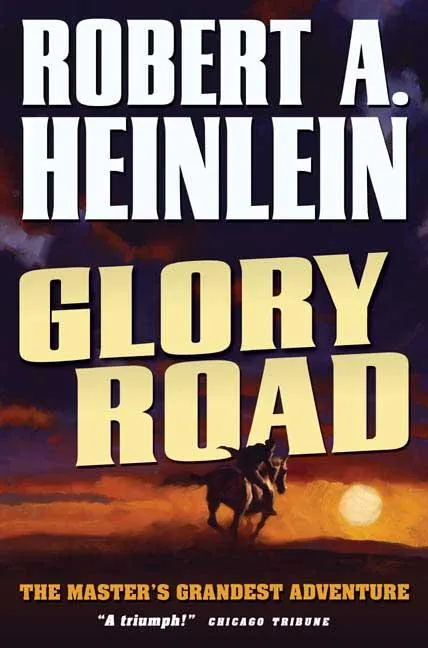
Glory Road
Report an issue
Tell us what's wrong and we'll take a look.
Thanks – we got it. We'll review and follow up if needed.
E. C. "Scar" Gordon was on the French Riviera recovering from a tour of combat in Southeast Asia, but he hadn't given up his habit of scanning the Personals in the newspaper. One ad in particular leapt out at him:
"ARE YOU A COWARD? This is not for you. We badly need a brave man. He must be 23 to 25 years old, in perfect health, at least six feet tall, weigh about 190 pounds, fluent English, with some French, proficient in all weapons, some knowledge of engineering and mathematics essential, willing to travel, no family or emotional ties, indomitably courageous and handsome of face and figure. Permanent employment, very high pay, glorious adventure, great danger. You must apply in person, rue Dante, Nice, 2me étage, apt. D."
How could you not answer an ad like that, especially when it seemed to describe you perfectly? Well, except maybe for the "handsome" part, but that was in the eye of the beholder anyway. So he went to that apartment and was greeted by the most beautiful woman he'd ever met. She seemed to have many names, but agreed he could call her "Star." A pretty appropriate name, as it turned out, for the empress of twenty universes.
Robert A. Heinlein's one true fantasy novel, Glory Road is as much fun today as when he wrote it after Stranger in a Strange Land. Heinlein proves himself as adept with sword and sorcery as with rockets and slide rules and the result is exciting, satirical, fast-paced, funny and tremendously readable -- a favorite of all who have read it. Glory Road is a masterpiece of escapist entertainment with a typically Heinleinian sting in its tail. Tor is proud to return this all-time classic to hardcover to be discovered by a new generation of readers.
Robert A Heinlein
Robert Anson Heinlein (July 7, 1907 - May 8, 1988) was an American science-fiction author, aeronautical engineer, and retired Naval officer. Sometimes called the "Dean of Science Fiction Writers," he was among the first to emphasize scientific accuracy in his fiction and was thus a pioneer of the subgenre of hard science fiction. His published works, both fiction and non-fiction, express admiration for competence and emphasize the value of critical thinking. His work continues to influence the science-fiction genre and modern culture.
Heinlein became one of the first American science-fiction writers to break into mainstream magazines such as The Saturday Evening Post in the late 1940s. He was one of the best-selling science-fiction novelists for many decades, and he, Isaac Asimov, and Arthur C. Clarke are often considered the "Big Three" of English-language science fiction authors. Notable Heinlein works include Stranger in a Strange Land, Starship Troopers (which helped mold the space marine and mecha archetypes) and The Moon Is a Harsh Mistress. His work sometimes had controversial aspects, such as plural marriage in The Moon is a Harsh Mistress, militarism in Starship Troopers and technologically competent women characters that were strong and independent, yet often stereotypically feminine - such as Friday. Heinlein used his science fiction to explore provocative social and political ideas, and to speculate how progress in science and engineering might shape the future of politics, race, religion, and sex. Within the framework of his science-fiction stories, Heinlein repeatedly addressed certain social themes, such as the importance of individual liberty and self-reliance, the nature of sexual relationships, the obligation individuals owe to their societies, the influence of organized religion on culture and government, and the tendency of society to repress nonconformist thought. He also speculated on the influence of space travel on human cultural practices. Heinlein was named the first Science Fiction Writers Grand Master in 1974. Four of his novels won Hugo Awards. In addition, fifty years after publication, seven of his works were awarded "Retro Hugos"--awards given retrospectively for works that were published before the Hugo Awards came into existence. In his fiction, Heinlein coined terms that have become part of the English language, including "grok," "waldo," and "speculative fiction," as well as popularizing existing terms like "TANSTAAFL," "pay it forward," and "space marine." He also anticipated mechanical computer-aided design with Drafting Dan and described a modern version of a waterbed in his novel Beyond This Horizon, though he never patented nor built one. In the first chapter of the novel Space Cadet he anticipated the cellphone, 35 years before Motorola invented the technology. Several of Heinlein's works have been adapted for film and television.More by Robert A Heinlein







Why Readwise Books?
Readwise Books is an ebook & audiobook platform that automatically logs how much you and your friends read, making it fun and easy to read more. Learn more →