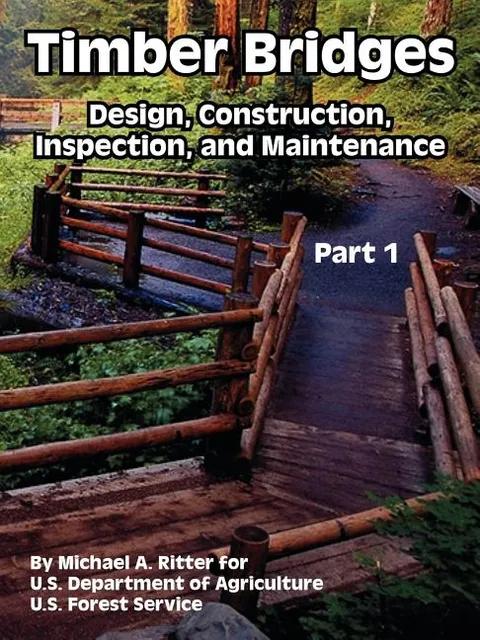
Timber Bridges
Design, Construction, Inspection, and Maintenance (Part One)
Report an issue
Tell us what's wrong and we'll take a look.
Thanks – we got it. We'll review and follow up if needed.
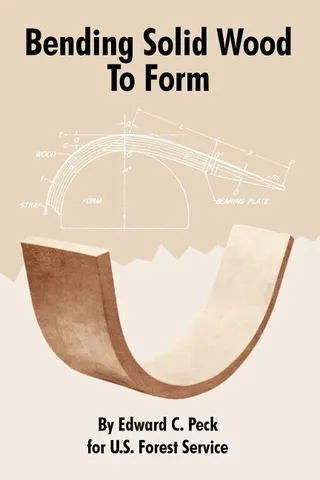
Timber's strength, light weight, and energy-absorbing properties furnish features desirable for bridge construction. Timber is capable of supporting short-term overloads without adverse effects. Contrary to popular belief, large wood members provide good fire resistance qualities that meet or exceed those of other materials in severe fire exposures. From an economic standpoint, wood is competitive with other materials on a first-cost basis and shows advantages when life cycle costs are compared. Timber bridges can be constructed in virtually any weather conditions, without detriment to the material. Wood is not damaged by continuous freezing and thawing and resists harmful effects of de-icing agents, which cause deterioration in other bridge materials. Timber bridges do not require special equipment for installation and can normally be constructed without highly skilled labor. They also present a natural and aesthetically pleasing appearance, particularly in natural surroundings. The misconception that wood provides a short service life has plagued timber as a construction material. Although wood is susceptible to decay or insect attack under specific conditions, it is inherently a very durable material when protected from moisture. Many covered bridges built during the 19th century have lasted over 100 years because they were protected from direct exposure to the elements. In modem applications, it is seldom practical or economical to cover bridges; however, the use of wood preservatives has extended the life of wood used in exposed bridge applications. Using modem application techniques and preservative chemicals, wood can now be effectively protected from deterioration for periods of 50 years or longer. In addition, wood treated with preservatives requires little maintenance and no painting. Another misconception about wood as a bridge material is that its use is limited to minor structures of no appreciable size. This belief is probably based on the fact that trees for commercial timber are limited in size and are normally harvested before they reach maximum size. Although tree diameter limits the size of sawn lumber, the advent of glued-laminated timber (glulam) some 40 years ago provided designers with several compensating alternatives. Glulam, which is the most widely used modem timber bridge material, is manufactured by bonding sawn lumber laminations together with waterproof structural adhesives. Thus, glulam members are virtually unlimited in depth, width, and length and can be manufactured in a wide range of shapes. Glulam provides higher design strengths than sawn lumber and provides better utilization of the available timber resource by permitting the manufacture of large wood structural elements from smaller lumber sizes. Technological advances in laminating over the past four decades have further increased the suitability and performance of wood for modern highway bridge applications.
Michael Ritter
Michael Ritter wurde 1967 in Wien geboren, wo er als Verleger und Literaturwissenschaftler lebt. Zahlreiche literaturwissenschaftliche Veröffentlichungen sind von ihm erschienen. Er schreibt historische Kriminalromane und Thriller. Zuletzt erschienen im Gmeiner-Verlag die Krimis rund um den Kriminaloberinspektor Dr. Otto W. Fried »Wiener Hochzeitsmord« und »Wiener Machenschaften«.
More by Michael Ritter
















Why Readwise Books?
Readwise Books is an ebook & audiobook platform that automatically logs how much you and your friends read, making it fun and easy to read more. Learn more →