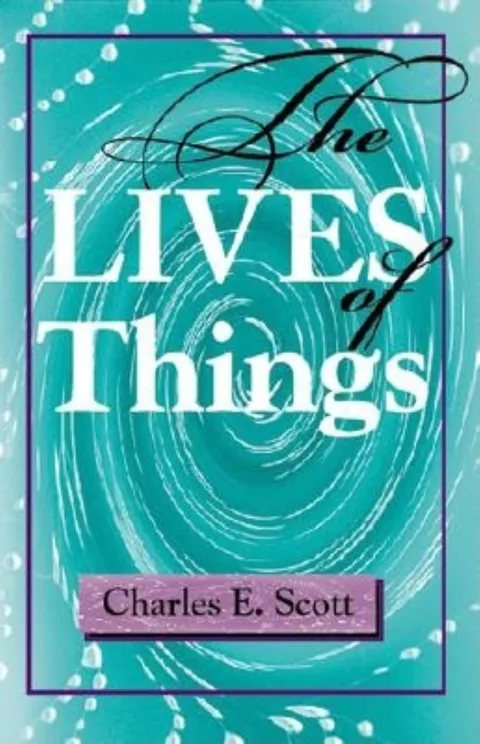
The Lives of Things
Report an issue
Tell us what's wrong and we'll take a look.
Thanks – we got it. We'll review and follow up if needed.
"[Scott] argues that things have lives beyond our cognitive grasp but are nonetheless formative of memories . . . thought, language, and action" (Choice). In The Lives of Things, Charles E. Scott reconsiders our relationships with ordinary, everyday things and our capacity to engage them in their particularity. He takes up the Greek notion of phusis, or physicality, as a way to point out limitations in refined and commonplace views of nature and the body as well as a device to highlight the often-overlooked lives of things that people encounter. Scott explores questions of unity, purpose, coherence, universality, and experiences of wonder and astonishment in connection with scientific fact and knowledge. He develops these themes with lightness and wit, ultimately articulating a new interpretation of the appearances of things that are beyond the reach of language and thought. "Like Foucault and Levinas before him, though in very different ways, Scott makes an oblique incision into phenomenology . . . [it is] the kind of book to which people dazed by the specters of nihilism will be referred by those in the know." —David Wood "Refreshing and original." —Edward S. Casey "This new work situates Scott . . . as a leading American scholar in the Continental tradition. In this important new contribution, he argues that things have lives beyond our cognitive grasp but are nonetheless formative of memories (biological, institutional, and cultural), thought, language, and action. Scott's argument underscores the importance of the physicality (phusis) of things, which has been sidelined in philosophical thought. Dewey's and Heidegger's consideration of physicality and the relation between the pragmatist and Continental traditions are built on to develop an account of phusis that emphasizes animation, lightness, density, and the thereness of physicality. Scott's analysis of density, luminosity, and physicality in Foucault's and Heidegger's work and of the displacement of subjectivity is incisive and critical. His final chapter on nihilism is a significant contribution in rethinking nihilism's negative connotations and resituating it as allowing for a multiplicity of discourses, for regions of recognition, and for life-affirming experiences. Scott's wit and personal experiences are woven throughout the text. Highly recommended for upper-division undergraduates through faculty." —N. A. McHugh, Choice
Charles E Scott
Charles E. Scott is Distinguished Professor of Philosophy, Emeritus, Vanderbilt University and Emeritus Professor of Philosophy, Pennsylvania State University. He is the author of numerous books including Living with Indifference, The Lives of Things, and The Time of Memory.
More by Charles E Scott


Why Readwise Books?
Readwise Books is an ebook & audiobook platform that automatically logs how much you and your friends read, making it fun and easy to read more. Learn more →